
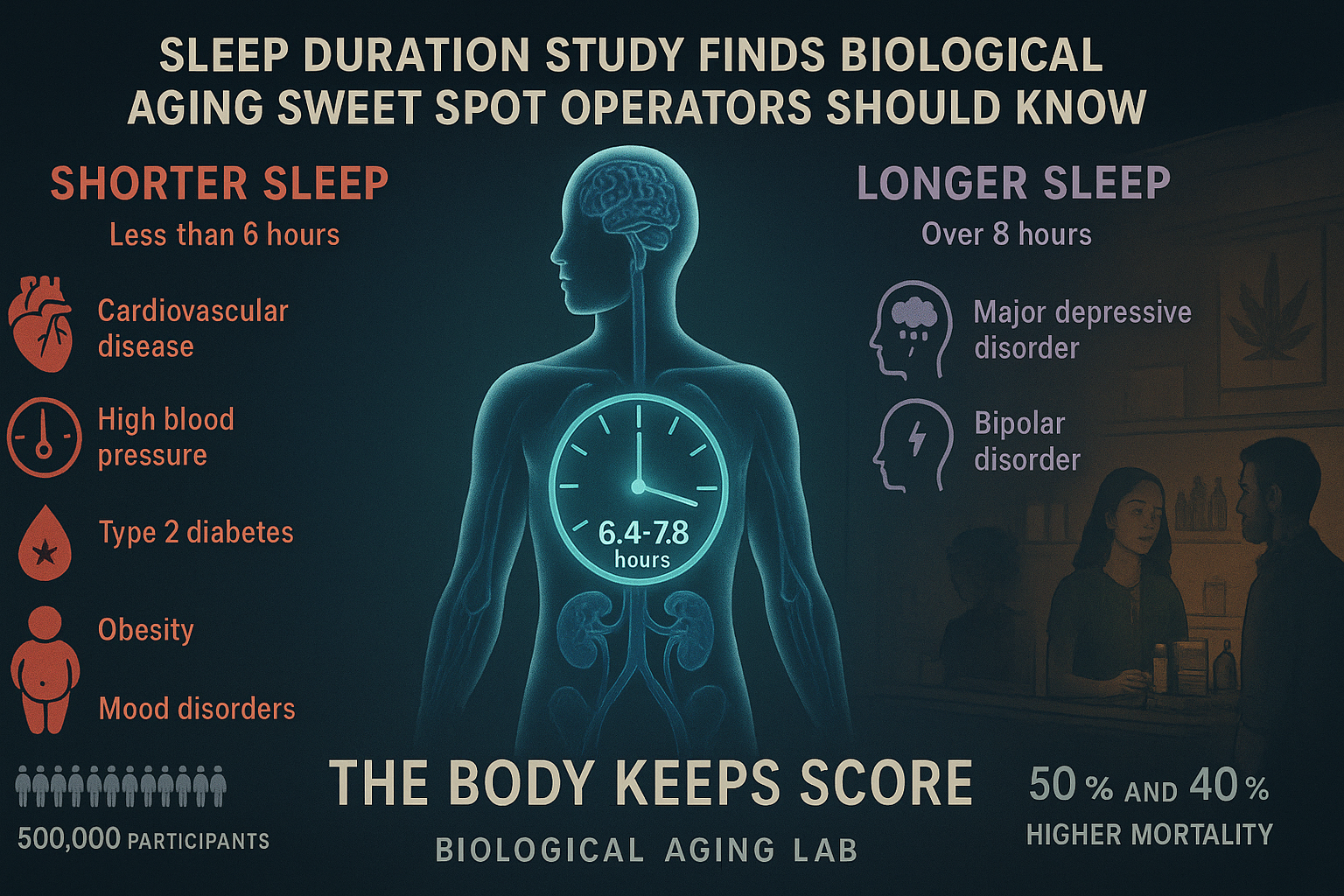
A large-scale study published in Nature has found that sleeping between 6.4 and 7.8 hours per night sits at the optimal range for slowing biological aging across multiple organ systems - and that both short and long sleep durations carry measurably higher risks of serious health conditions and early death. The research drew on data from roughly 500,000 participants and examined 23 separate biological aging markers. For cannabis retail operators and wellness-adjacent brands positioning products around sleep, recovery, or stress - this is the kind of science worth understanding precisely, not loosely.
Biological Age Is Not the Same as the Number on Your Driver's License
The distinction the researchers draw between chronological age and biological age matters here. Chronological age is fixed - it ticks forward regardless of behavior. Biological age reflects how hard your cells and tissues have actually worked: the accumulated load of stress, diet, environment, genetics, and rest. Nine of the 23 aging clocks in the study showed a consistent pattern - sleeping fewer than six hours or more than eight was associated with faster biological aging, higher disease risk, and a greater likelihood of dying earlier from any cause.
That's not a subtle signal. Short sleepers carried a 50% higher risk of death from any cause; long sleepers, a 40% higher risk. Both patterns accelerated the body's biological wear - just through different mechanisms and affecting different systems.
Short Sleep and Long Sleep Do Different Damage
Here's what's striking about the findings: the direction of harm depends on which direction you drift from that 6.4-to-7.8-hour window. They're not mirror images of each other.
Sleeping too little was linked to a broad sweep of physical health risks - cardiovascular disease, high blood pressure, type 2 diabetes, obesity, kidney disease, low back pain, osteoarthritis, and mood and substance use disorders. Wide-ranging, systemic, and largely metabolic. Sleeping too much, by contrast, showed up more concentrated in the brain, associated with conditions including major depressive disorder, schizophrenia, bipolar disorder, and ADHD. The researchers were careful to note that extended sleep duration may signal an underlying condition already in motion rather than being a direct cause of those outcomes - a meaningful distinction.
The exact optimal range also shifted depending on the organ system being examined and the participant's gender. To put it plainly: there isn't one universal number, but the general window held across the dataset with enough consistency to be meaningful.
What This Means for Wellness Positioning in Cannabis Retail
Cannabis retail doesn't operate in a vacuum. A significant portion of adult-use consumers cite sleep support as a reason for purchasing - particularly products in the tincture, edible, and low-dose formats that have gained shelf space in dispensaries over the past several years. Budtenders are frequently asked about sleep-related products, and wholesale menus reflect steady demand in that category.
The compliance risk is real and worth stating plainly: no licensed cannabis retailer, brand, or marketing team should be pointing to this study - or any sleep science - as evidence that cannabis products promote healthy aging or optimize sleep duration. Regulatory bodies in virtually every adult-use jurisdiction prohibit health or therapeutic claims in cannabis advertising and product labeling. Making causal links between cannabis consumption and the findings of a sleep-aging study would almost certainly cross that line.
What operators can do is train staff to discuss consumer questions about sleep thoughtfully and within compliance guardrails - acknowledging what customers are asking without making claims the science, and certainly no licensed product testing, supports. COA data tells you potency and contaminants. It does not tell you whether a product improves sleep quality or biological aging outcomes. The gap between those two things is where liability lives.
A Broader Reminder About What the Body Keeps Score On
The researchers' framing - that "the body keeps score" on rest, not just in the brain but across organs - is a useful lens for anyone in an industry where the workforce operates on irregular hours. Dispensary staff, compliance managers running late-night inventory reconciliations, delivery drivers on split shifts, and multi-state operators managing operations across time zones are all subject to the same biological pressures the study describes.
Workforce health is an operational issue. Chronic sleep deprivation affects cognitive function, error rates, compliance accuracy, and judgment - none of which are abstractions in an environment where seed-to-sale tracking errors can trigger regulatory scrutiny and where a single point-of-sale discrepancy can complicate an audit. That's not alarmism. It's just what the research, now at this scale, confirms.
The sweet spot - roughly six and a half to just under eight hours - isn't a hard target so much as a reasonable anchor. The data behind it is large enough to take seriously.