
Clinicians who build careers in oncology rarely arrive by accident. The field draws people through early encounters with serious illness - a family member's diagnosis, a mentor's example, a particular kind of moral seriousness about what medicine is for. That initial drive is real. The problem is what the system does with it over time.
When Passion Becomes a Liability
Research drawn from oncology, organizational psychology, and behavioral science has begun to draw a sharp distinction between what scholars call harmonious passion - where work fits within a life - and obsessive passion, where identity and work collapse into one another. Oncology, structurally, rewards the latter. Long hours, high emotional stakes, and cultures that equate exhaustion with commitment create conditions where the very traits that make someone good at this work are the same traits that eventually break them.
The consequences follow a predictable sequence. Escalating clinical complexity, administrative burden, and workforce shortages compound over time. Moral distress accumulates - not from single dramatic events, but from the grinding experience of being unable to practice according to one's values. Attrition follows. The clinicians who leave are often the most experienced, the most principled, and the hardest to replace.
What's striking here is that this isn't a character or commitment problem. The evidence is clear: these are structural failures masquerading as individual ones.
Values Alignment as Operational Infrastructure
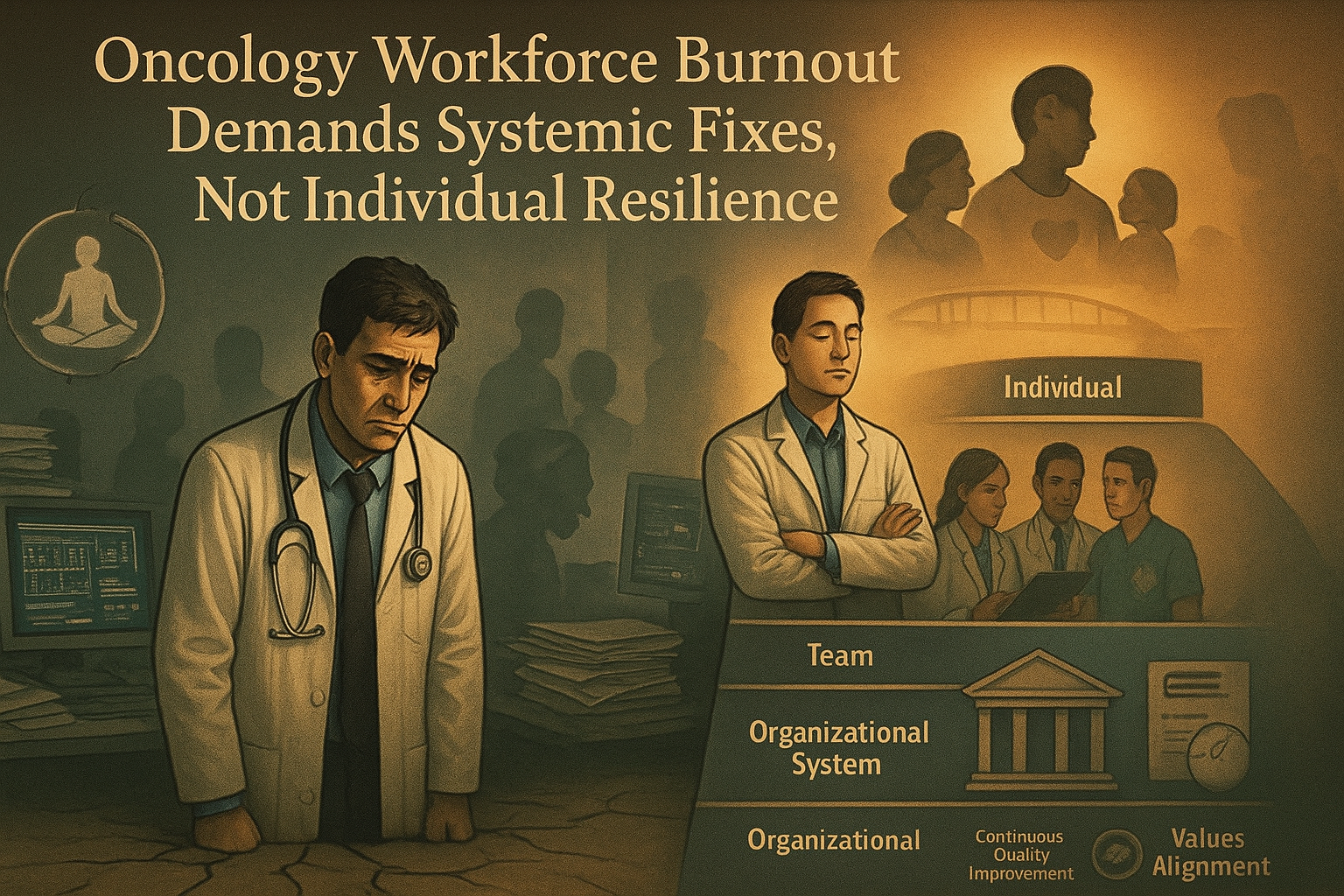
A growing body of work reframes clinician well-being not as a personal wellness matter - a yoga class, a meditation app - but as a dynamic interaction between individuals, teams, and systems. The distinction matters, because it changes where responsibility sits and where investment needs to go.
Values-based practice, as a framework, asks organizations to treat alignment between a clinician's core values and their daily working conditions as an operational requirement, not a nice-to-have. When that alignment breaks down - when what a clinician believes good care looks like diverges from what the system allows them to deliver - the result isn't merely dissatisfaction. It produces moral distress, which the literature links directly to burnout and departure.
Purpose-centered work also intersects with what researchers describe as meaning-centered or spiritual activity - not in any narrowly religious sense, but in the sense of feeling that one's effort matters, connects to something larger, and produces genuine good. Advocacy work, for example, is increasingly understood as a vehicle for that kind of meaning, not a distraction from clinical duties.
A Three-Tiered Framework That Redistributes Accountability
The chapter under review proposes a three-tiered implementation framework - operating at individual, organizational, and system levels - specifically designed to prevent the most common failure mode in well-being initiatives: offloading the entire burden onto the individual clinician.
At the individual level, the evidence supports developing psychological flexibility - the capacity to engage with discomfort, uncertainty, and complexity without being destabilized by them. Personal growth through embracing difficulty, rather than avoiding it, is framed as a skill to be cultivated, not a personality trait one either has or doesn't.
At the team level, the framework emphasizes codesign - involving clinicians in shaping the conditions under which they work, rather than delivering solutions to them. This is not a soft management principle. Teams that participate in designing their workflows, communication norms, and support structures consistently show better cohesion and lower attrition than those where conditions are imposed from above.
At the organizational and system level - and this is where the framework breaks from most wellness programs - accountability shifts to enabling structures. That means continuous quality improvement applied to the work environment itself, not just clinical outcomes. It means treating workforce sustainability as a measurable operational objective. In practice, though, this requires institutional will that many healthcare organizations have not yet demonstrated.
The Long View: Purpose Over Passion
Passion is not a strategy. It is a starting condition - useful, even essential, but not self-sustaining under sustained pressure. The evidence reviewed here argues that what actually keeps skilled clinicians in oncology over the long term is not the preservation of that original fire, but the construction of conditions in which purpose remains legible, values remain operative, and the work remains connected to why it began.
That is a systems design problem. And like most systems design problems, it will not be solved by asking the people most burdened by the current system to simply endure it more gracefully.