
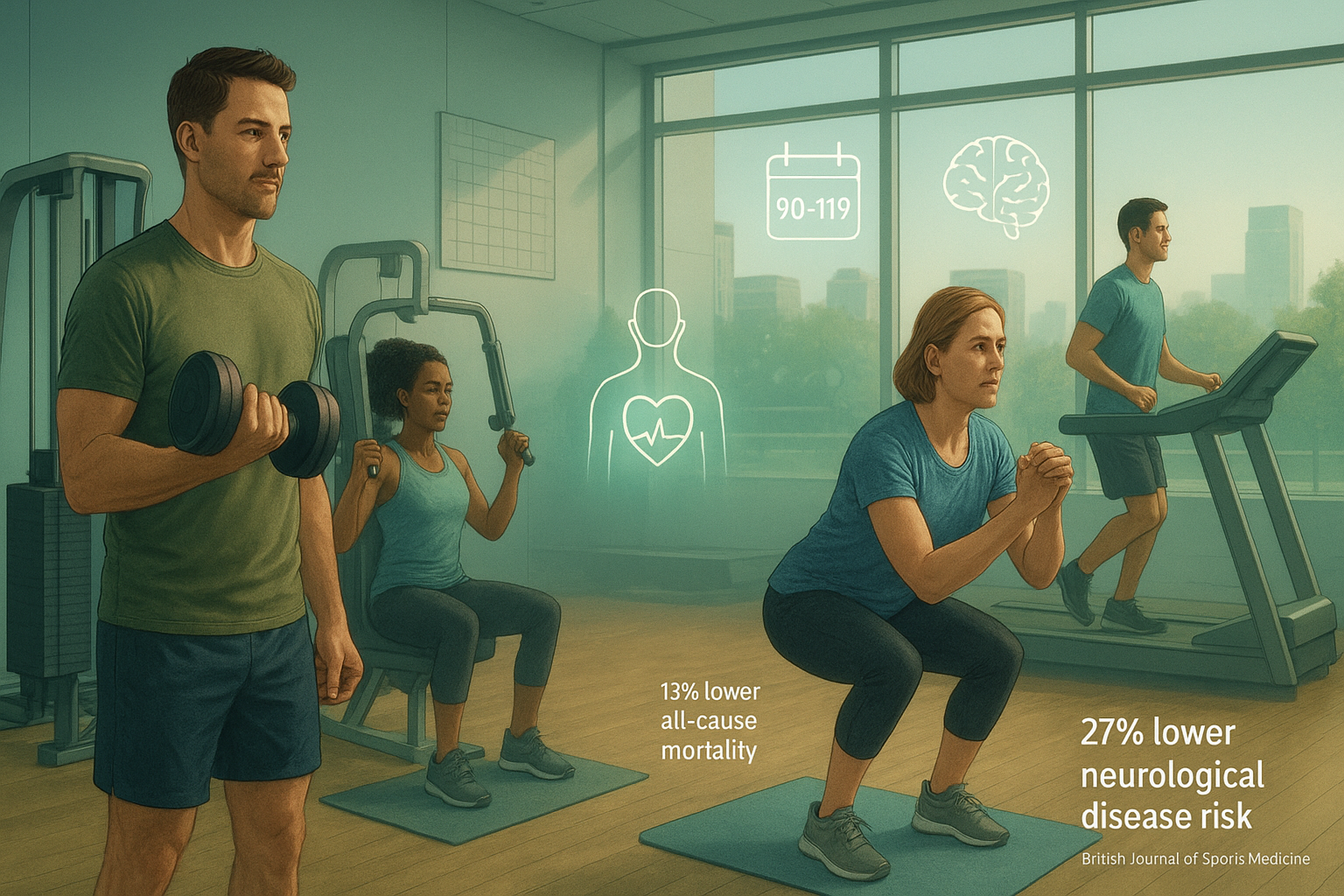
A large observational study published in the British Journal of Sports Medicine suggests that adults who maintain a consistent resistance training routine - weightlifting, weight machines, and similar modalities - may face meaningfully lower odds of early death. The research tracked more than 147,000 U.S. adults across three long-term health studies spanning up to 30 years, making it one of the more substantial datasets applied to this question. The findings point to a specific window of weekly effort where benefit appears most pronounced.
The clearest mortality reduction emerged at roughly 90 to 119 minutes of resistance training per week - not at elite volumes, but at what most working adults could reasonably fit into a weekly schedule. Participants in that range showed a 13% lower risk of death from any cause, a 19% lower risk of cardiovascular death, and a 27% lower risk of death from neurological disease. Even modest amounts - 30 to 59 minutes weekly - were associated with a 12% lower risk of cancer death. These associations held after researchers adjusted for age, smoking, diet quality, alcohol intake, family history, and aerobic activity levels. Worth noting for operators building wellness-adjacent programs or employee benefit structures - whether in regulated retail sectors like cannabis pos alaska markets or broader health-conscious business environments - the data suggest that meaningful protective association begins at relatively accessible training volumes, not at extreme commitment levels.
What the study does not claim matters just as much as what it does. This is associational research - the design cannot establish that resistance training directly caused the mortality reductions observed. Participants self-reported their exercise habits, which introduces the possibility of inaccuracy. The study also did not measure training intensity, only duration. So two people reporting 100 minutes per week of resistance training could have had wildly different actual workloads. The researchers acknowledged these constraints directly.
Where Aerobic Activity Fits - and Where It Doesn't Add More
The lowest overall mortality risk in the study belonged to people doing both high aerobic activity and moderate-to-high resistance training together. That finding tracks with what exercise science has suggested for years. Here's the catch, though: for people already logging very high aerobic volumes - roughly the equivalent of five to six hours of jogging or eleven hours of brisk walking per week - adding resistance training did not appear to push risk any lower. There's a ceiling effect, in other words. More is not always more. For the majority of adults nowhere near that aerobic ceiling, the combination approach still offered the clearest benefit.
The Practical Threshold - And Why It Matters for Busy Professionals
Ninety to 119 minutes per week breaks down to somewhere between two and three moderate sessions. That is not an intimidating commitment on paper - but adherence over years is where the actual difficulty lives. The study followed participants over decades, and the mortality association reflects sustained habits, not short-term programs. Fitness professionals have long argued that consistency at moderate intensity outperforms sporadic high-intensity effort, and this dataset supports that framing. Going beyond 120 minutes per week did not appear to compound the all-cause mortality benefit, which is a useful guardrail for anyone inclined to treat more volume as automatically better.
The research does not prescribe a specific program, and no single study should be treated as clinical guidance. What it does offer is a directional signal: resistance training, maintained consistently at moderate weekly volumes, appears associated with meaningfully better long-term survival odds - even when controlling for other known health factors. For the broader conversation around workplace wellness, employee retention, and health-forward organizational culture, that signal carries weight regardless of industry context.