
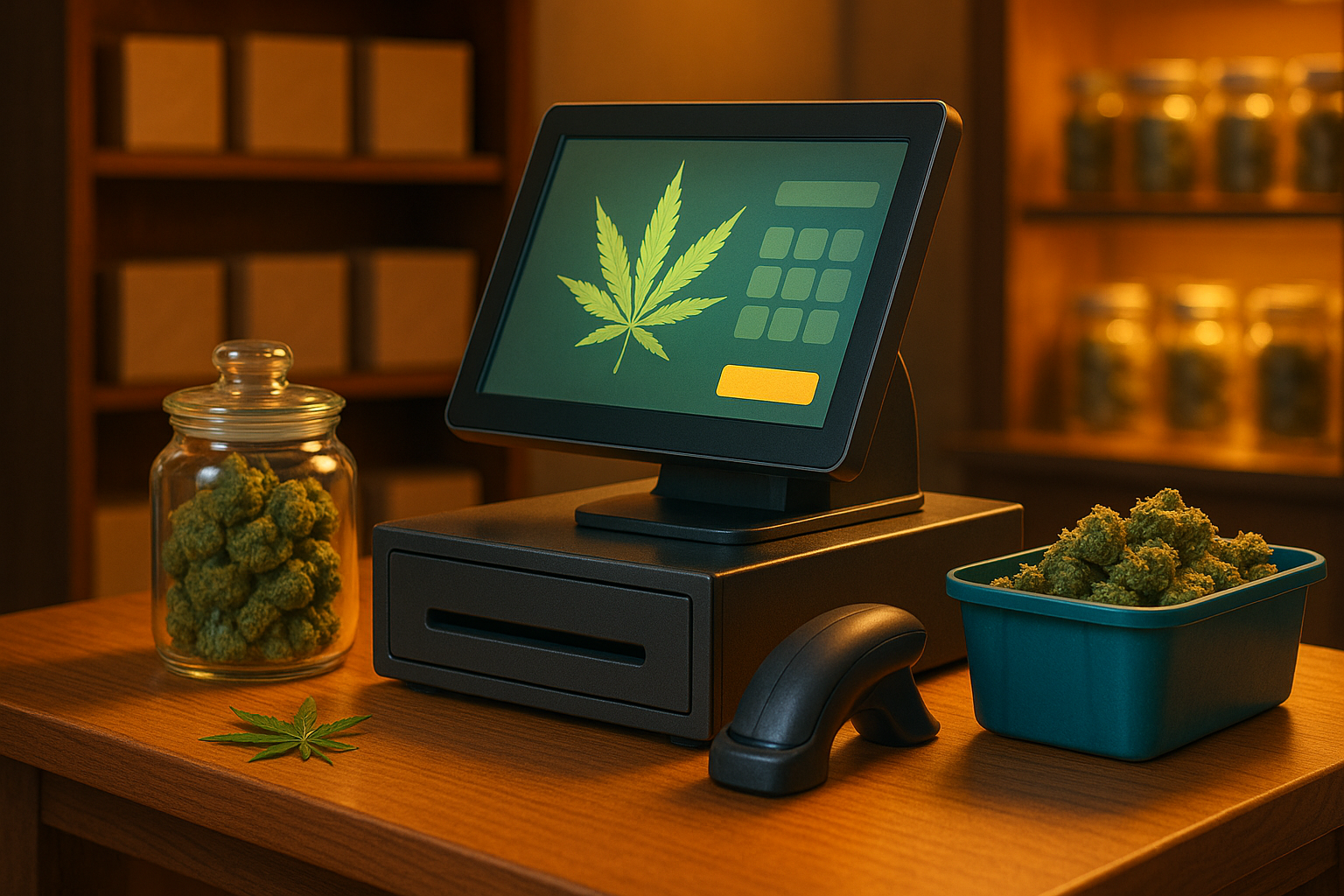
Running a cannabis dispensary without the right point-of-sale infrastructure is less like managing a retail business and more like running a pharmacy with a cash register. The regulatory burden alone - seed-to-sale tracking, state reporting, age verification, purchase limits - would overwhelm any generic retail system. Yet many dispensary owners, especially those opening their first location, default to off-the-shelf software and spend months patching the gaps. Choosing the right cannabis dispensary POS system from the start isn't a luxury; it's a foundational operational decision.
The cannabis retail market has matured considerably. Customers now expect loyalty programs, express pickup, and digital menus. Regulators expect real-time inventory accuracy and audit-ready transaction logs. Operators need dashboards that surface margin data, staff performance, and compliance flags - all in one place. The category of marijuana retail software has evolved to meet these demands, but the options are far from equal. Some platforms are built specifically for cannabis; others are adapted from hospitality or pharmacy tech. Knowing the difference matters. Whether you're opening a single medical dispensary or scaling a multi-location adult-use operation, evaluating medical marijuana POS software against a clear set of criteria will save you from costly migrations and compliance headaches down the road.
This guide breaks down every dimension worth evaluating: compliance architecture, inventory infrastructure, hardware compatibility, customer-facing features, reporting depth, and total cost. By the end, you'll have a framework for making a decision that fits your market, your team, and your growth trajectory.
Understanding What Makes Cannabis POS Different from General Retail Software
The Compliance Layer That Never Sleeps
Standard retail POS systems are built around transactions: scan, charge, receipt. Cannabis retail adds a mandatory compliance layer that sits between every one of those steps. Depending on your state, your POS must integrate with a seed-to-sale tracking platform - most commonly Metrc, BioTrackTHC, or LEAF - and push sales data automatically with each transaction. A failure in that integration doesn't just create a data gap; it can trigger a license violation.
Purchase limits present another compliance requirement that general software simply wasn't designed to handle. In medical programs, patients may have physician-recommended purchase quantities that differ from adult-use caps. A proper medical cannabis point of sale software solution enforces these limits automatically, flags approaching thresholds in real time, and maintains a patient purchase history that syncs with your state's registry where required.
Age verification is table stakes, but the sophistication matters. A cannabis POS should support ID scanning with automatic age calculation, not just a manual checkbox. Some platforms also support integration with third-party ID verification services for delivery operations, where staff are handling verification in the field without a fixed terminal.
Why General Retail Software Falls Short
The instinct to adapt a general retail platform - particularly one the owner already knows - is understandable. The problem is architectural. General platforms weren't built with state-specific compliance rules in mind, which means cannabis-specific features are either missing entirely or bolted on as integrations that create fragile dependencies.
Inventory management is the clearest example. Generic retail systems track SKUs and quantities. Cannabis requires tracking by package, batch, and often individual unit weight. A general platform might tell you that you have 500 grams of a product in stock; a proper cannabis inventory tracking software tells you which packages those grams are in, which harvest batch each package came from, and how much of that inventory is allocated to pending online orders. That granularity is what regulators expect and what operators need to catch shrinkage early.
Built for Cannabis vs. Cannabis-Adapted
The market now includes platforms built specifically for cannabis retail and general platforms that have added cannabis compliance modules. Both can work, but the trade-offs are real. Cannabis-native platforms tend to have tighter state integrations, more developed compliance automation, and support teams who understand the regulatory context. Adapted platforms may offer more flexibility for retailers who operate hybrid businesses - a cannabis shop with a CBD wellness product line sold in states without cannabis licensing, for example.
When evaluating any system, ask the vendor directly: was this platform built for cannabis from the ground up, or was compliance added after initial development? The answer shapes how the software behaves under pressure - during a state audit, a system update that changes reporting requirements, or a sudden regulatory change in your jurisdiction.
Compliance and Regulatory Integration: The Non-Negotiable Foundation
Seed-to-Sale Tracking System Compatibility
Every cannabis dispensary POS system worth considering must integrate natively with your state's required seed-to-sale tracking platform. "Native integration" is the key phrase. Some vendors offer integration through a third-party middleware layer - a connector that syncs data between the POS and the state system on a schedule. Others push data directly and in real time with each transaction. The difference becomes critical when a product is flagged in the state system, or when an audit pulls up discrepancies between your records and the state's.
Before committing to any platform, verify the following about its state integration:
- Which state tracking systems does it support, and is your state on the list?
- Is integration direct or through a third-party connector?
- How quickly are sales reported to the state system after a transaction is completed?
- What happens to compliance reporting if your internet connection drops mid-transaction?
- How does the vendor handle state system updates or API changes?
Medical vs. Adult-Use Compliance Requirements
Medical and adult-use cannabis programs operate under different regulatory frameworks, and a dispensary serving both markets - or planning to transition between them - needs software that handles both without requiring manual configuration overrides at the point of sale.
In medical programs, the POS typically needs to verify patient registry status, track physician recommendations, enforce purchase limits based on those recommendations, and in some states, generate reports tied to patient outcomes data. A robust medical cannabis point of sale software solution manages patient profiles with expiration dates, sends alerts when a patient's medical card is nearing renewal, and maintains HIPAA-adjacent data handling practices for patient records.
Adult-use compliance is somewhat simpler in structure - age verification and purchase limits - but higher in transaction volume, which puts pressure on system speed and uptime. Dispensaries that operate both programs simultaneously need a POS that can distinguish between transaction types and apply the correct rule set automatically based on the customer's verified status.
Audit Readiness and Reporting
A state audit is not a hypothetical risk for cannabis retailers - it's a scheduled reality in most jurisdictions. Your POS should generate compliance reports that match the format regulators expect, on demand, without requiring a data export and manual reformatting. The best dispensary management software includes pre-built compliance report templates that mirror state audit requirements, with date-range filtering, employee-level transaction breakdowns, and package-level inventory reconciliation.
Ask vendors whether their reporting tools have been used in actual state audits and what the outcome was. A vendor confident in their compliance infrastructure will answer that question directly.
Cannabis Inventory Tracking Software: Precision That Protects Your License
Package-Level vs. SKU-Level Tracking
The distinction between package-level and SKU-level inventory tracking is one of the most important technical factors in evaluating cannabis software. SKU-level tracking tells you how much of a product you have. Package-level tracking tells you exactly which regulatory packages make up that quantity, where each package came from, and its complete chain of custody from the cultivator to your sales floor.
Regulators don't just want to know that you sold 3.5 grams of a specific strain. They want to know which package that product came from, whether the package was received in compliance with transfer requirements, and whether your on-hand quantity matches the state system's records for that package. Cannabis inventory tracking software that operates at the package level makes this reconciliation automatic rather than manual.
Real-Time Inventory Accuracy and Shrinkage Detection
Inventory shrinkage is a universal retail problem, but in cannabis it carries regulatory consequences in addition to financial ones. A discrepancy between your POS inventory and your physical count doesn't just affect margin - it can trigger a compliance investigation. Real-time inventory tracking, where the POS adjusts counts immediately with each sale, transfer, and return, is the baseline requirement.
Beyond real-time tracking, stronger platforms include automated alerts when inventory levels fall below expected thresholds given recent sales velocity, or when physical counts entered during daily reconciliation don't match the system's expected on-hand quantities. Some dispensary management software solutions also flag statistical anomalies - a particular employee's transactions consistently showing higher-than-average voids or returns, for example - that can surface internal shrinkage before it becomes a significant problem.
Receiving, Transfers, and Returns
Inventory management in cannabis dispensaries extends beyond the sales floor. Every product that enters your facility arrives as a transfer from a licensed cultivator or distributor, and that transfer must be received into your system with the correct package IDs, weights, and batch information. The receiving workflow in your POS should guide staff through verifying transfer manifests against physical product, flagging discrepancies before the transfer is accepted, and automatically updating state system records upon receipt confirmation.
Product returns - whether from customers or back to the distributor - require an equally structured workflow. Cannabis returns carry compliance implications because the product's chain of custody must remain traceable. A POS system that handles returns as simple inventory reversals without updating the corresponding state records is creating a compliance gap with every return transaction it processes.
Marijuana Retail Software Features That Drive Sales and Customer Experience
Digital Menus and E-Commerce Integration
Modern cannabis customers frequently browse product menus online before visiting a dispensary. Many place orders for express pickup or delivery. Your marijuana retail software should maintain a real-time product menu that reflects actual inventory - not a catalog that was last updated manually three days ago. When a product sells out on the floor, it should disappear from the online menu instantly. When a new batch arrives and is received into inventory, it should be available for ordering within minutes.
Integration with cannabis e-commerce and menu platforms - platforms that power the online browsing and ordering experience - should be native, not a manual export-import cycle. The strongest POS systems maintain a bidirectional sync with menu platforms, updating availability and pricing in both directions without staff intervention.
Customer Loyalty Programs and CRM
Loyalty programs in cannabis retail work differently than in general retail because cannabis advertising restrictions limit how dispensaries can reach customers through external channels. A well-designed loyalty program embedded in the POS becomes one of the few compliant mechanisms for customer retention. Points-based programs, visit rewards, and birthday discounts are all standard, but the real value comes from how the POS ties loyalty data to purchase history.
A customer profile in your dispensary management software should tell budtenders what a customer typically buys, what they've tried recently, whether they're a medical patient, and what their current loyalty balance is - all before the consultation begins. That context makes the interaction more efficient and more likely to result in a satisfying purchase. It also reduces the burden on budtenders to remember individual customer preferences across hundreds of daily interactions.
Budtender Tools and the Point-of-Sale Interaction
The point-of-sale terminal is where budtender training, product knowledge, and customer service converge. A well-designed cannabis dispensary POS system supports that interaction rather than complicating it. Terminals should display product details - cannabinoid profiles, terpene content, effect categories, and staff notes - without requiring the budtender to navigate multiple screens or application windows.
Queue management is another feature that directly affects the customer experience during busy periods. A POS that includes floor queue management, pre-check-in for registered customers, and order routing to specific budtenders or stations reduces wait times and improves throughput without requiring additional staff. In states that allow express or self-service kiosk models, some POS platforms support kiosk integrations that let returning customers complete familiar purchases with minimal staff interaction.
Dispensary Management Software: Operations Behind the Counter
Employee Management and Access Controls
Every cannabis dispensary operates in an environment where transaction-level accountability is both a regulatory expectation and an operational necessity. Your dispensary management software should support granular, role-based access controls that determine what each staff member can see and do within the system. Budtenders should be able to process sales; managers should be able to apply discounts above a threshold; only administrators should be able to access inventory adjustments or void completed transactions.
Shift reports tied to individual employee IDs, transaction logs that capture who processed what and when, and the ability to pull employee-level performance data are standard in robust platforms. These features matter not just for internal management but for responding to compliance inquiries that require demonstrating who had access to specific functions during a specific period.
Multi-Location Management
Dispensary groups managing multiple locations need software that provides a unified view across all sites without requiring them to log into each location separately. Centralized reporting, shared customer profiles, transferable loyalty balances, and the ability to push menu updates or pricing changes across all locations simultaneously are the baseline expectations for enterprise-level marijuana retail software.
Inventory transfers between locations - which are regulated events in most states - should be managed within the POS with automated manifest generation and state-system reporting. A budtender at Location A should not be pulling inventory from Location B's records without that transfer being properly documented, and the POS should enforce that process rather than leaving it to staff judgment.
Financial Reporting and Cash Management
Cannabis retail remains predominantly cash-heavy in many markets due to banking access limitations. A POS system that treats cash management as an afterthought is a significant operational liability. Strong cannabis POS platforms include structured cash handling workflows: opening drawer counts, mid-shift reconciliations, closing counts, and variance reporting that identifies discrepancies down to the transaction level.
Beyond cash, financial reporting should give operators a complete picture of sales performance by product category, by employee, by time of day, and by customer segment. Margin reporting at the product level requires that the POS carry cost data alongside retail pricing - something that connects directly to the receiving workflow where cost-per-unit is recorded when inventory is accepted into the system.
Hardware, Integrations, and Total Cost of Ownership
Hardware Requirements and Compatibility
A cannabis dispensary POS system doesn't exist in isolation - it runs on hardware that needs to fit your physical environment and withstand the demands of retail operations. Most cannabis POS platforms are cloud-based and support either proprietary hardware kits or off-the-shelf tablets and terminals running iOS or Android. The choice between proprietary and flexible hardware affects both upfront cost and long-term maintenance.
Peripheral compatibility matters more than it might seem. ID scanners, label printers, receipt printers, cash drawers, and payment terminals all need to connect reliably to your POS. Before selecting a system, verify that the hardware you plan to use - or already own - is on the vendor's supported hardware list. A POS that works beautifully on its own proprietary terminal but requires expensive replacements of your existing equipment changes the total cost calculation substantially.
Payment Processing in the Cannabis Industry
Cannabis payment processing remains one of the more complicated aspects of dispensary operations. Traditional credit card processing is unavailable to most cannabis retailers due to federal banking restrictions, though this landscape continues to shift. Most dispensaries currently work with a combination of cash, debit (via PIN debit networks), cashless ATM solutions, or cannabis-specific payment platforms.
Your POS system needs to support whatever payment method your merchant services provider offers - and preferably more than one, to reduce single-point-of-failure risk. Ask vendors which payment processors they've certified integrations with, and verify that those processors are actively operational in your state. A payment integration that was certified eighteen months ago but has since changed its operating model is not a reliable foundation for your payment infrastructure.
Evaluating Total Cost of Ownership
Software pricing in the cannabis POS category varies considerably. Most platforms charge a monthly subscription fee that scales with the number of terminals, locations, or transaction volume. Some charge additional fees for specific integrations - state compliance reporting, e-commerce menu sync, or loyalty programs. Hardware costs, onboarding fees, and ongoing support tiers add to the real cost that the base subscription price doesn't reflect.
When comparing platforms, build a complete cost model that includes:
- Monthly software subscription at your anticipated terminal and location count
- Integration fees for state compliance reporting and e-commerce platforms
- Hardware costs, including replacement and warranty terms
- Onboarding and training fees
- Customer support tier - whether 24/7 support is included or costs extra
- Contract length and early termination terms
A platform with a lower monthly subscription but mandatory annual hardware refresh fees may cost more over three years than a higher-priced option with no hardware requirements. The comparison only becomes meaningful when the full picture is visible.
Evaluating Vendors: What to Ask Before You Sign
Customer Support and Implementation
Cannabis retail doesn't operate on a standard 9-to-5 schedule, and neither do the problems that arise in it. A state compliance reporting failure at 9 PM on a Saturday is not a problem that can wait until Monday morning. When evaluating vendors, support availability and response time are not secondary considerations - they are core infrastructure.
Verify the specific support tier you're being sold: Is 24/7 support included in your subscription, or does it cost extra? What is the average response time for critical issues? Is support available via phone, or only through a ticketing system? Request references from dispensaries of similar size and location to yours, and ask those references directly about their experience with support during compliance-critical situations.
Implementation Timeline and Training
Going live on a new cannabis dispensary POS system is not a plug-and-play process. State integrations need to be configured and tested. Inventory needs to be migrated or entered. Staff need to be trained on workflows that differ significantly from previous systems. A realistic implementation timeline for a single-location dispensary switching platforms typically runs several weeks when done properly.
Ask vendors to walk you through their implementation process in detail. Who manages the state compliance integration setup? Who validates that inventory migration is accurate before go-live? What training resources are available - live sessions, on-demand video, documentation? What ongoing training support is available when you hire new staff six months from now?
Scalability and Product Roadmap
The cannabis industry continues to evolve rapidly, and the software powering dispensary operations needs to evolve with it. When you commit to a POS platform, you're also committing to the vendor's ability to keep pace with regulatory changes, add support for new states, and develop features that the market will increasingly expect.
Ask vendors about their development roadmap. What features are in active development? How do they handle state regulatory changes - how quickly are updates deployed when a state changes its reporting requirements? How are customers notified of updates, and how is downtime managed during system updates? A vendor with a strong track record of proactive compliance updates is a materially different risk profile than one that relies on customers to flag regulatory changes and then responds reactively.
Frequently Asked Questions
Can a cannabis dispensary use a general retail POS system like Square or Shopify?
Technically, cannabis dispensaries cannot use most general retail POS platforms under their standard terms of service, as those companies prohibit cannabis-related businesses due to federal restrictions. Beyond the terms-of-service issue, general platforms lack the seed-to-sale tracking integrations, package-level inventory management, and state compliance reporting features that cannabis regulations require. Using a general platform in a cannabis context creates both legal exposure and operational gaps that can result in compliance violations.
How does a cannabis POS system integrate with Metrc or other state tracking systems?
Integration typically works through an API connection between the POS and the state tracking platform. When a transaction is completed, the POS automatically pushes the sale data - including package IDs, quantities, and customer information where required - to the state system. The quality of this integration varies by vendor: some offer real-time direct pushes, others batch updates on a schedule. Confirm the specific integration method with your vendor, as real-time direct integration is significantly more reliable than scheduled batch syncing.
What happens to my dispensary's compliance reporting if the POS goes offline?
Most modern cannabis POS platforms include an offline mode that allows transactions to continue processing during an internet outage. Sales are queued locally and synced to the state tracking system when connectivity is restored. However, the specific behavior during offline mode - including whether purchase limits are still enforced and whether inventory counts remain accurate - varies by platform. This is a critical question to ask during vendor evaluation, particularly if your dispensary operates in an area with unreliable internet service.
Is a separate dispensary management software system needed in addition to a POS?
The best cannabis POS platforms integrate dispensary management functions - employee management, financial reporting, inventory oversight, and customer relationship tools - into a single system. Separate dispensary management software is sometimes used by larger operations that need capabilities beyond what their POS provides, such as advanced analytics, multi-location HR management, or accounting integrations. For most single or small multi-location operations, a comprehensive cannabis POS platform eliminates the need for a separate management layer.
How long does it typically take to implement a new cannabis POS system?
A realistic implementation timeline for a single-location dispensary runs two to six weeks, depending on the complexity of inventory migration, the speed of state compliance integration configuration, and staff training requirements. Multi-location operations typically require longer timelines, especially when inventory needs to be migrated and reconciled across sites. Rushing implementation to meet an arbitrary go-live date is one of the most common causes of post-launch compliance problems - allow adequate time for testing before processing live transactions.
What should I look for in cannabis inventory tracking software specifically for medical dispensaries?
Medical dispensaries need inventory tracking that connects to patient profiles and purchase history, enforces physician-recommended purchase limits automatically, and maintains records in a way that supports state registry verification. The software should also handle medical-specific product categories - such as physician-formulated products or dosage-specific items - with the same package-level precision applied to adult-use products. HIPAA-adjacent data handling practices for patient records are an additional requirement that purely adult-use-focused platforms may not address adequately.