
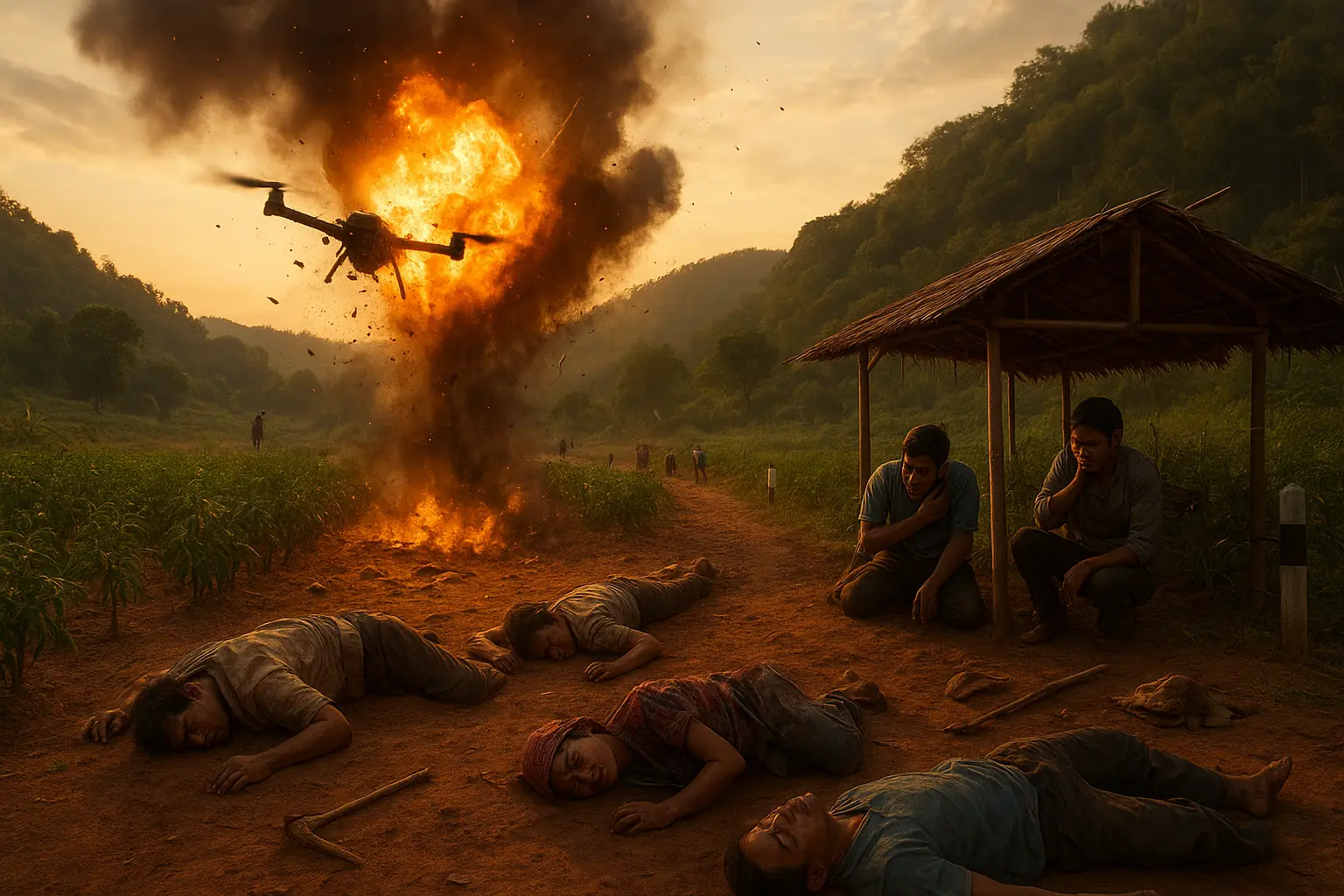
A drone weapon originating from Myanmar's ongoing civil conflict crossed the border into Thailand's Tak Province on Tuesday and detonated near a chilli farm, killing three Myanmar migrant workers and wounding two others. Thai police confirmed the deaths, describing how the drone struck a tree on the Thai side of the border before exploding. The incident marks a direct, deadly spillover of Myanmar's internal armed conflict onto foreign soil and raises immediate questions about border security and the safety of migrant labor populations in Thailand's border regions.
Tak Province sits opposite Myanmar's Karen (Kayin) State, a region long contested between Myanmar's military and various ethnic-minority armed factions - many of which have fought for autonomy since the country's independence in 1948. The 2021 military coup dramatically intensified that conflict, and Karen rebel groups currently control much of the state. Heavy fighting on Tuesday sent scores of Myanmar civilians fleeing across the border into Thailand, according to local media reports. Both the Myanmar military and ethnic armed organizations are known to deploy drones in combat operations. Local police chief Anusorn Dungkong, speaking to AFP, confirmed that the two surviving victims were transported to hospital for treatment, though which side launched the drone that crossed the border remains undetermined. This ambiguity is itself a feature of the conflict - attribution is difficult, accountability is diffuse, and it is migrant workers in industries like agriculture, construction, and manufacturing who absorb the consequences. Professionals operating in adjacent sectors, from logistics and supply chain to retail compliance, might consider how technology-driven risk assessment tools - similar in concept to the operational tracking systems underpinning a cannabis dispensary pos system new york operators rely on for real-time inventory and compliance data - increasingly factor cross-border instability into workforce and supply continuity planning.
The victims were agricultural laborers. That detail matters. Thailand hosts a large population of Myanmar migrant workers concentrated in farming, fishing, and construction - sectors with limited labor protections and significant geographic exposure in border zones. The chilli farm where Tuesday's blast occurred represents exactly the kind of informal rural employment that absorbs displaced populations from Myanmar, particularly as the civil war continues to push people across the border. These workers operate outside most formal safety nets, and incidents like this - however rare - expose the structural vulnerability of that labor population.
A Conflict With Expanding Geographic Reach
Myanmar's armed conflict has never been contained strictly within its borders. Refugee flows, cross-border trade disruption, and occasional stray munitions have periodically affected Thailand, China, and India. What has changed since 2021 is the scale and sophistication of the fighting. The Myanmar military's post-coup campaign against both established ethnic armed organizations and newer People's Defence Forces has drawn in more actors, expanded the geographic front lines, and introduced more advanced battlefield technology - including drones.
The use of combat drones by non-state armed groups in Myanmar is documented and growing. Improvised and commercially sourced drone platforms have been adapted for surveillance and strike roles by multiple factions. That a drone detonated inside Thai territory is a serious escalation in terms of international optics, even if accidental. Thai authorities have not publicly attributed the strike to a specific belligerent, and given the complexity of the Karen State conflict - where multiple armed organizations operate in overlapping areas - a definitive attribution may not come quickly, if at all.
What This Means Beyond the Border
For Thailand, the immediate operational question is how to respond to an incident it cannot easily assign blame for. Diplomatic pressure is complicated when the offending party is unidentified and possibly a non-state actor. Thai border security has long managed the tension between maintaining a functional economic relationship with Myanmar - including accepting migrant labor - and managing the instability that the conflict generates.
The deeper issue is structural. Migrant workers from Myanmar fill labor gaps across Thailand's agricultural and manufacturing sectors. Their proximity to active conflict zones - both in their country of origin and, now, potentially in Thai border territories - represents a real and underacknowledged occupational hazard. Three people are dead. Two are in hospital. And the broader labor population they were part of has no clear recourse, no formal warning system, and limited official protection against threats that originate in a foreign war.
That is not an abstraction. It is a policy and humanitarian failure waiting for a response that has not yet arrived.