
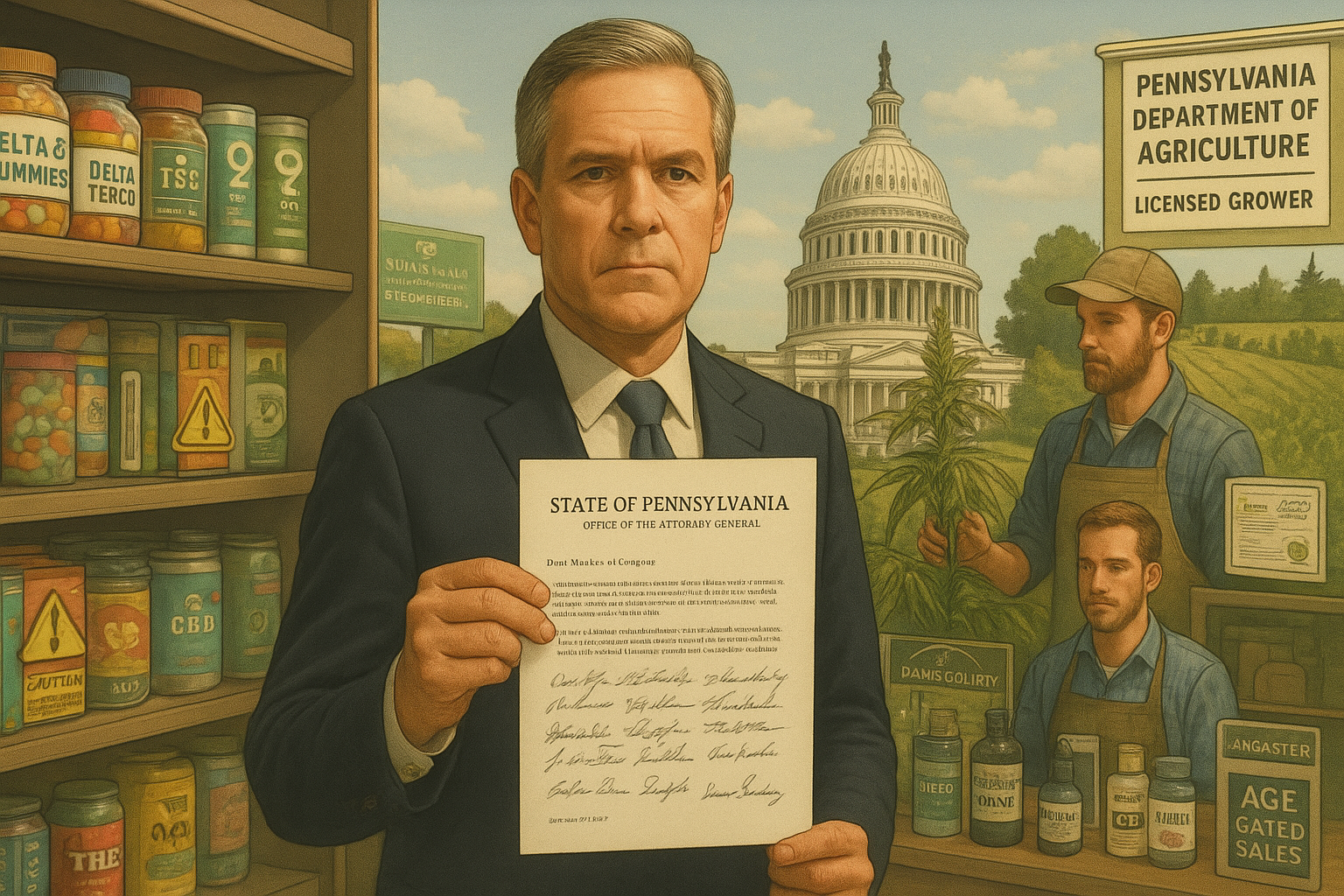
Pennsylvania Attorney General Dave Sunday has joined more than 30 counterparts nationwide urging Congress to let a federal redefinition of hemp take effect on schedule this November, rather than delay it further. The letter frames the change as a public-safety fix for what law enforcement calls a loophole that let intoxicating THC products flood gas stations and convenience stores with little oversight. Hemp advocates in Pennsylvania counter that the same fix would wipe out legitimate CBD manufacturers and farmers who never touched the intoxicating market in the first place.
The mechanics matter here, and they're easy to miss if you're not close to the supply chain. Under the 2018 Farm Bill, hemp was defined by delta-9 THC content alone - under 0.3% at harvest, and you're legal. That measurement gap let processors concentrate other THC isomers, like delta-8 and delta-10, into drinks, gummies, and vapes that never technically crossed the marijuana threshold but still got people high. The new federal language closes that by counting total THC and capping finished containers at 0.4 milligrams. For retailers trying to keep compliant inventory straight across categories, the shift underscores why back-end systems matter; operators researching options like cannabis POS for South Carolina dispensaries already know how much tracking precision separates a compliant shelf from a liability.
Two Markets, One Rule
Here's the catch: the rule doesn't distinguish well between a synthetic-heavy gas station vape and a CBD sleep tincture sold at a wellness shop, both get caught in the same container standard. Pennsylvania's Department of Agriculture has licensed 170 hemp growers and 32 processors, and roughly half of those growers sell into consumable manufacturing - CBD drinks, gummies, tinctures. National trade group U.S. Hemp Roundtable estimates the new statute would eliminate about 95% of the hemp consumable market, intoxicating or not. That's not a narrow fix. That's a market reset.
Jake Sitler, who runs a Lancaster hemp beverage company and heads the Pennsylvania Hemp and Cannabis Guild, isn't arguing against regulation. He's arguing for the right kind: published lab results and certificates of analysis, natural-hemp sourcing requirements instead of synthetic cannabinoid shortcuts, and age-gated sales modeled on alcohol retail. His company already follows those voluntarily. His point, made plainly, is that pulling products off shelves entirely doesn't eliminate demand - it just pushes it toward unregulated sellers with no COAs and no age checks at all.
What Operators and Growers Are Actually Facing
For a hemp farmer like Adams County's Tyler Shannon, who sells roughly $400,000 in crop annually to CBD manufacturers and none to intoxicant producers, the new rule isn't abstract. It's existential. He argues Congress conflated raw-plant THC limits with finished-product limits back in 2018 and never fixed the distinction - leaving compliant operators exposed to a crackdown aimed at a different problem entirely.
- Total-THC standard replaces delta-9-only measurement, closing the isomer loophole
- 0.4 milligram per-container cap effectively bans delta-8 and delta-10 consumables
- Industrial fiber and grain hemp remain exempted from the new definition
- Pennsylvania's hemp sector reportedly contributes up to $1.4 billion annually to the state economy
Sunday's office has been blunt about priorities, stating that protecting children from unregulated intoxicants outweighs concerns about business viability. That's a defensible public-safety position. But it sidesteps the operational reality facing licensed growers and processors who built compliant businesses under the rules Congress itself wrote in 2018 - and now face a November deadline with no transition period, no distinction for non-intoxicating goods, and, according to industry advocates, no realistic path to retool product lines in time.
A Delay Bill Now Sits With the Senate
As of early August, the Senate was weighing whether to attach a delay to a stopgap funding bill, over objections from some members who want the THC redefinition enforced without exception. For dispensary operators, wholesalers, and compliance teams tracking adjacent hemp-derived SKUs, the outcome will shape wholesale menus and shelf categories well beyond Pennsylvania. A three-month delay wouldn't resolve the underlying tension between intoxicant enforcement and non-intoxicating commerce - it would just buy time for a more precise statute, assuming Congress uses it.