
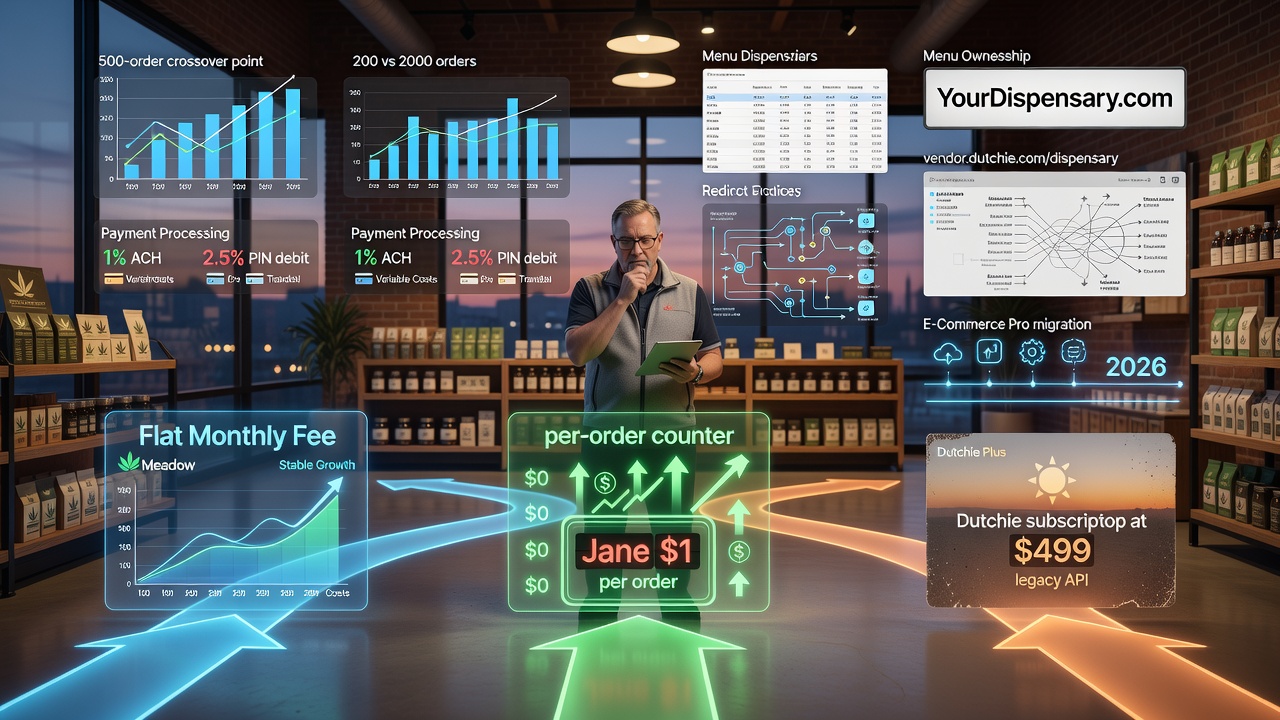
There is no single best online ordering system for a dispensary, and anyone selling you one is skipping the part that actually determines your bill. The right move is to pick the pricing meter first and let the platform follow. Dutchie bills a subscription per location. Jane is reported to charge roughly a dollar per completed order. Meadow charges a flat monthly fee per location with no transaction cut. Run the same revenue through all three and the gap between the bills dwarfs any difference in the feature list.
The crossover math nobody runs before a demo
Here's the calculation that decides this, and no vendor page will do it for you, because it's unflattering to whichever one you're reading. Divide a monthly subscription by a per-order fee and you get the volume at which the two meters cost the same. At a reported $499 a month against a reported $1 per order, that crossover lands around 500 online orders a month, or roughly 17 a day. Below it, per-order billing is cheaper and flexes down in a slow month. Above it, the subscription wins and every extra order is free at the margin. A store doing 200 online orders is overpaying badly on a flat fee. A store doing 2,000 is overpaying just as badly per order.
Pull your last ninety days of online orders and use the median month, not your best one. That single number will usually eliminate at least one platform outright, which is worth more than any side-by-side feature chart. Payment processing sits on top of whichever meter you choose: ACH or pay-by-bank commonly runs about 1% to 1.5% of the sale, and PIN debit is reported at roughly 2.5% to 4% plus around 50 cents per transaction. None of these vendors publish a public rate card, so treat every published figure as a way to sanity-check a quote, not as the quote itself.
There's a second effect the meter decides that owners rarely think through up front: it sets who benefits from your growth. On a per-order meter, the software bill rises in lockstep with online sales, which makes the vendor a quiet partner in every promotion the store runs. On a flat fee, it doesn't - which is precisely what Meadow markets against. Neither structure is wrong on its face. But if the plan for next year is to double online ordering, know which of those two contracts just got signed.
The Dutchie Plus sunset is a forced decision, not a renewal
Operators running a custom storefront on Dutchie Plus are on a harder clock. Dutchie announced E-Commerce Pro on August 26, 2025, alongside a Certified Partner Program, and reporting on its 2026 roadmap describes the legacy Plus headless API being retired, with support for existing Plus customers running through the end of 2026. That is a forced migration aimed squarely at the operators who invested the most in a custom front end.
The decision isn't whether to move. It's where. This is the one moment in a multi-year contract when switching vendors costs nothing extra, because the rebuild is already budgeted. Doing that rebuild on a different platform costs the same rebuild. Dutchie reports retailers on E-Commerce Pro generate more than 50% higher online sales than the industry average and grow 10% faster, with more than 6,500 dispensary partners - figures that are Dutchie's own, about Dutchie, and self-reported uplift numbers in retail software rarely control for the fact that early upgraders tend to be the stores already growing. Ask for methodology. If none is offered, price the platform on the meter and the migration effort instead.
Budget the move as an engineering project, not a settings change. A custom storefront carries URL structures, redirects, analytics and payment integration, and the part that fails most often is the cutover, not the build. Get the redirect map written before anyone writes code, and sequence the storefront migration ahead of any payments change - moving both at once is how a launch weekend turns into a cash-only weekend.
Who owns the menu matters more than any comparison chart shows
Some ordering products host your menu on your own domain. Others host it on a vendor domain or subdomain, with your store as a page inside their site. Jane offers a native menu product on your own domain, which is the arrangement that protects you. A hosted menu on a vendor's domain means the authority you build with every product page and review accrues to the vendor, not to you, and it doesn't come with you when you leave.
Test it in ten seconds before signing anything: ask where the menu URL lives. If the answer contains the vendor's name instead of yours, you're renting your own storefront traffic. That's a defensible trade if the vendor sends demand the store couldn't generate alone - the real argument for marketplaces like Weedmaps or Leafly - but it should be a decision made on purpose, not a surprise found in year two.
- Product data: catalog fields, strain names, potency fields and variant structures rarely map cleanly between platforms; check them in a spreadsheet before import, not after.
- URLs: every ranking product and category page has an address; migrating without redirects discards years of earned traffic.
- Payments: confirm checkout processing isn't welded to the storefront contract, so one can change without forcing the other.
Whatever meter and platform a dispensary lands on, none of it pays for itself if customers can't find the store to begin with - which is a separate job from choosing software, and a compliance-and-visibility task that belongs on every operator's list regardless of which vendor wins the contract.