
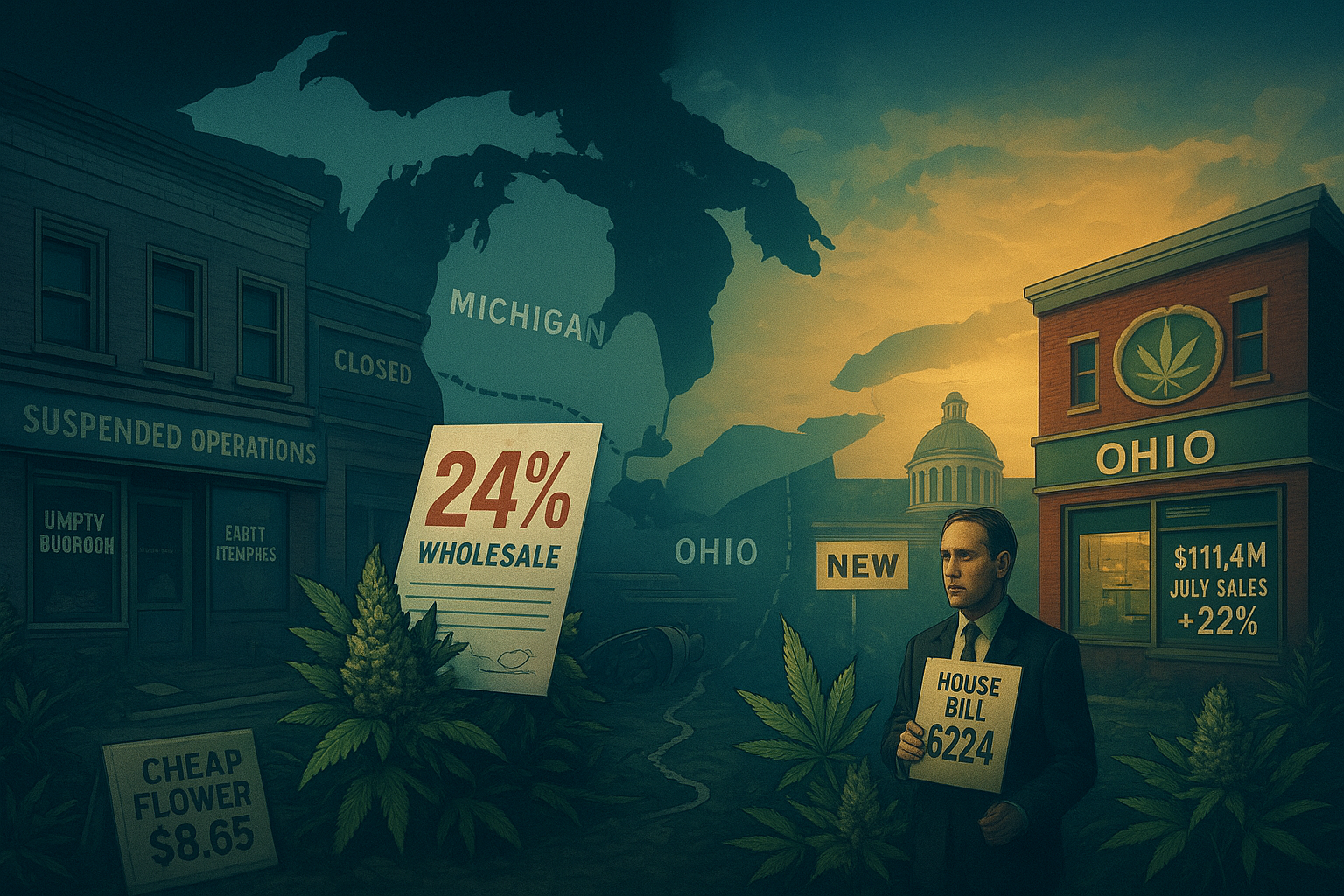
Michigan's cannabis sales dropped 5.1% year over year in July, to about $260.6 million. Ohio's newer recreational market climbed 22% over the same period, to roughly $111.4 million. Michigan still moves far more product than its neighbor, but the direction each market is heading has become impossible to ignore, and Michigan's new 24% wholesale marijuana tax is now squarely part of that conversation.
A Wholesale Tax Lands on Already Thin Margins
Michigan's wholesale levy, which took effect Jan. 1, applies to certain sales or transfers of recreational marijuana at the wholesale level. It sits on top of the taxes consumers already pay at checkout - a 10% marijuana excise tax and the standard 6% sales tax. State officials projected the wholesale tax would generate roughly $420 million a year for a neighborhood road fund. State Rep. James DeSana, R-Carleton, says that projection is off by a wide margin, and he's introduced House Bill 6224 to repeal the tax outright. The bill is a single sentence. It's also, in effect, a referendum on whether Michigan's cannabis industry can absorb one more fixed cost.
Here's the mechanism worth understanding: a wholesale tax gets baked into cost of goods before a product ever reaches a dispensary shelf. Cultivators and processors either eat the margin hit or pass it downstream to retailers, who are already discounting heavily to move inventory. In a market flooded with supply, passing costs to consumers isn't simple - price sensitivity is high, and shoppers can walk to the next storefront. That squeeze shows up in budroom decisions, wholesale menus, and eventually in payroll.
Closures in the Upper Peninsula Signal Broader Strain
Higher Love Cannabis Co. suspended operations at five of its nine Michigan dispensaries - in Crystal Falls, Escanaba, Houghton, Munising and Ontonagon - while keeping stores open in Ironwood, Marquette, Menominee and Norway. The company pointed directly to the wholesale tax as an added cost layered onto oversupply, price compression and falling revenue. It also said the pressure is pushing operators statewide toward consolidation, facility suspensions and job cuts.
That's a familiar pattern in maturing cannabis markets, but Michigan's version is unusually severe because of how cheap product has become. The state's average item price was $8.65 in July - the lowest among major markets Headset tracks - while Ohio's average sits around $30. Michigan consumers are still buying enormous volumes; the state remains on pace to sell more than 1.3 million pounds of flower in 2026. Volume isn't the problem. Revenue per unit is.
License Counts Hint at Contraction Already Underway
- Michigan had 836 active adult-use dispensary licenses as of June 30, down from 845 a year earlier.
- Cultivation licenses fell from 1,016 to 939 over the same period.
- Ohio's recreational market, launched in August 2024, remains smaller but is expanding retail and cultivation capacity.
What a Narrowing Price Gap Would Mean for Operators
Michigan's rock-bottom prices have long pulled Ohio consumers across the border, turning border towns into significant retail draws. That advantage hasn't vanished, but it isn't guaranteed to hold. If Michigan's tax burden and business failures continue trimming supply, prices could firm up. If Ohio's cultivation footprint keeps growing, its prices could soften. Neither shift happens overnight, but the gap between an $8.65 average item price and a $30 one is large enough that even modest convergence would reshape competitive dynamics on both sides of the state line.
For multi-state operators, wholesalers and brands with Midwest exposure, the practical takeaway is straightforward: don't treat Michigan and Ohio as fixed reference points. Underwriting new retail locations, wholesale supply agreements or point-of-sale and inventory-management investments now requires modeling a Michigan market where thinner margins and tax policy could accelerate closures, alongside an Ohio market where rapid growth may eventually invite the same oversupply dynamics Michigan is living through now.
Revenue Projections Depend on a Healthy Industry
Lansing wants road money from cannabis tax revenue. That revenue, though, depends on a legal industry that can stay open, keep compliance logs current, and generate taxable wholesale and retail transactions. If closures continue and sales keep sliding, the state may collect considerably less than the $420 million projection assumed. Michigan proved that consumers will buy cannabis in volume when it's cheap and available everywhere. Whether that model can coexist with a 24% wholesale tax - and with a faster-growing competitor next door - is the question lawmakers are now being asked to answer.