
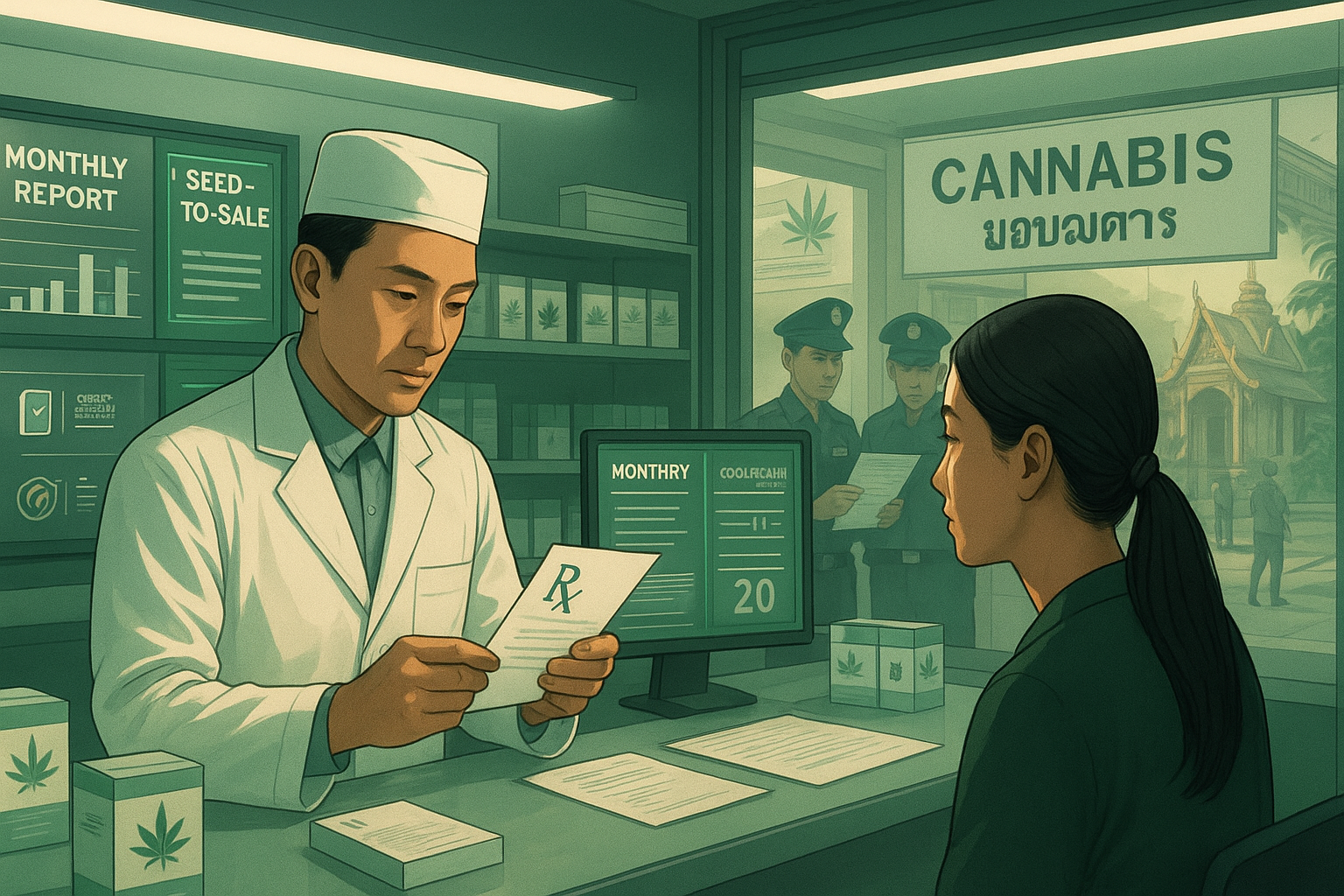
Thailand's Department of Thai Traditional and Alternative Medicine issued new enforcement guidelines on June 22, establishing license suspensions, possible revocations, and stricter compliance obligations for cannabis businesses operating under the country's evolving medical framework. The move is the clearest signal yet that the open, commercially driven model that emerged after Thailand's 2022 decriminalization is being replaced by something that looks far more like a state-supervised pharmaceutical channel than a retail market.
The broader arc here matters for any operator or investor watching international cannabis regulation. What Thailand built after 2022 - fast store openings, weed tourism, agricultural expansion, online sales, visible street-level advertising - grew without a comprehensive legal structure to organize who could sell, to whom, under what conditions, and with what traceability obligations. That gap is now being closed with enforcement teeth. For markets outside Thailand that are still maturing, the pattern is familiar: early permissiveness followed by regulatory correction. Operators in U.S. markets that run compliance-heavy dispensary operations - tracking inventory through tools like IndicaOnline POS Michigan to satisfy state seed-to-sale requirements - already understand the business cost of operating under a framework where compliance logs, licensed sourcing, and age-verification protocols are not optional. Thailand is now arriving at that same inflection point, just from a different starting position.
The enforcement guidelines issued by DTAM formalize a structure that was partially set in 2025, when Thailand's Public Health Ministry reclassified cannabis flower as a controlled herb and restricted its sale to the medical framework. Licensed stores can still operate, but the operating conditions have hardened: supply must come from certified sources meeting good agricultural and collection practices standards, monthly operational reports are required, sales must be tied to prescriptions from qualified professionals, and advertising - including digital channels - is tightly restricted.
What Suspensions and Revocations Actually Look Like
The new guidelines create a tiered enforcement structure. Minor violations - failure to keep required business reports on site, incomplete reporting, failure to submit reports to the registrar, non-compliant sourcing that doesn't meet GACP or equivalent agricultural standards, failure to display a license, or advertising controlled herbs commercially - may result in a 30-day suspension. That's not a slap on the wrist for a small operator; a month of suspension in a prescription-dependent model could mean losing established supply relationships and patient-facing staff.
More serious violations carry a 90-day suspension. Selling cannabis without a prescription from a qualified professional sits in this category, as does failing to report export details to the appropriate authorities. The prescription requirement is the operational hinge of the entire framework. Cannabis in Thailand is no longer being treated as a general retail SKU. It's being regulated the way a controlled medicine is - which means that operators who built their business model around walk-in sales, spontaneous transactions, or tourism-driven foot traffic are now fundamentally misaligned with the legal structure.
License revocation is reserved for what DTAM considers serious violations. These include filing false reports, selling cannabis to minors under 20, selling to students or pregnant and breastfeeding individuals without a prescription, permitting on-site use, operating vending machines, conducting online sales, or selling in prohibited locations such as temples, dormitories, or public parks. Multiple simultaneous violations can result in accumulated suspension periods, capped at 90 days total. Repeat offenses, though, skip the accumulation math entirely - a second offense can trigger immediate revocation.
The Compliance Pressure Operators Are Now Facing
To put it plainly: the list of revocable violations reads like a description of how a significant portion of the Thai cannabis market actually operated between 2022 and 2025. Online sales, visible storefronts without proper license display, products moving outside certified agricultural channels, retail environments where on-site consumption wasn't formally prohibited - these weren't fringe behaviors. They were common. DTAM's enforcement framework is essentially drawing a hard line through the middle of what the market normalized.
For operators trying to stay licensed, the compliance burden is now multi-dimensional. Traceability is required from cultivation through sale. Monthly reports need to be accurate, complete, and available on-site for inspection. Advertising - including anything on digital platforms - must not promote controlled herbs commercially. Sales require valid prescriptions. And licensed sourcing must meet specific agricultural standards, which means the informal grow operations that fed parts of the early market are no longer a viable supply chain option.
The practical effect for any operator still in the market is a forced formalization. Businesses that invested in physical infrastructure, supplier relationships with certified growers, and proper documentation systems are better positioned than those that relied on the loose operating environment of the boom years. The ones most exposed are operators who never built the backend compliance infrastructure - the reporting systems, the prescription verification workflows, the licensed supply agreements - because the enforcement pressure was never serious enough to require it. That calculation has changed.
The Bigger Tension Thailand Can't Resolve Through Enforcement Alone
There's a structural contradiction running through all of this. Thailand has genuine advantages as a cannabis producer - climate, agricultural knowledge, labor costs, and geographic access to Asian markets where regulated medical cannabis demand is growing. The country could, in theory, become a meaningful player in cannabis exports to legal markets. But the regulatory direction is narrowing, not widening, the operational window for the kind of commercial activity that would build that export capacity.
The Thai government's stated rationale for tighter enforcement centers on protecting minors and vulnerable populations, limiting non-medical use, and restoring order to a market that expanded faster than oversight mechanisms could follow. Those are legitimate policy concerns. The question for the industry is whether the enforcement framework, as currently structured, creates enough legal certainty for serious operators to invest in the infrastructure required to comply - or whether the instability of the regulatory environment, which has shifted significantly multiple times in just a few years, makes long-term investment difficult to justify.
What's striking here is that the Thai case isn't unique in its arc. It's a compressed version of the regulatory corrections that have played out in various forms across U.S. state markets, European pilot programs, and other early-adopter jurisdictions. The sequence is recognizable: broad opening, rapid unregulated growth, public pressure over access and safety, regulatory tightening, enforcement formalization. Thailand simply moved through that cycle faster than most. The enforcement guidelines issued in June are, in that context, less a surprise and more an arrival - the point where rules written on paper become consequences operators actually feel.