
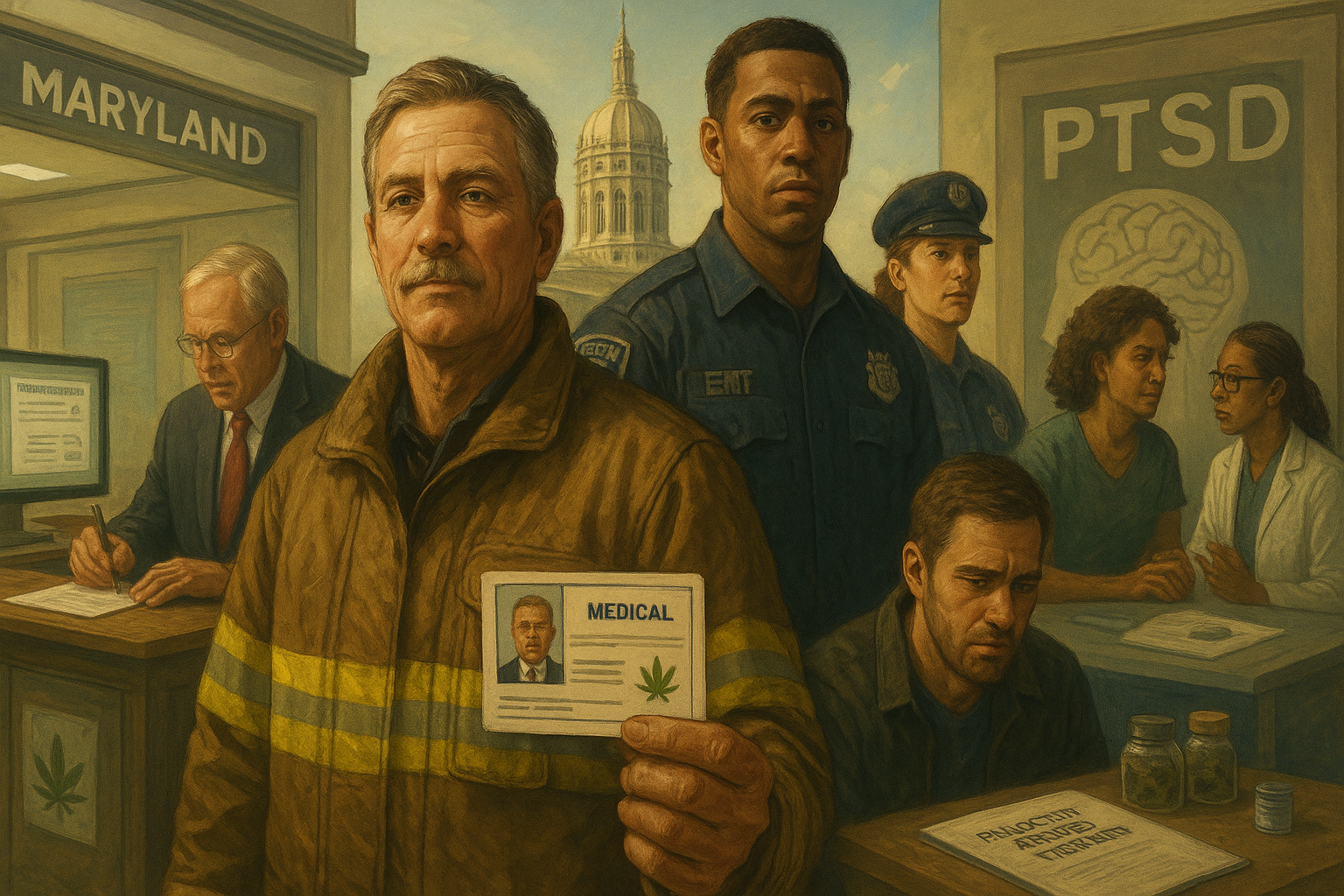
A quiet but meaningful policy shift is moving through state legislatures this year: multiple states are expanding access to non-traditional treatments - including medical cannabis and psychedelic-assisted therapies - to help firefighters, police officers, and emergency medical workers manage post-traumatic stress. The moves signal a broader rethinking of mental health support for first responders, and several of the new laws have direct implications for cannabis-licensed businesses, dispensary operators, and compliance teams tracking medical program eligibility.
Maryland's approach is the most directly relevant to the cannabis industry. A new law, effective this October, prohibits employers from discriminating against firefighters, EMTs, paramedics, and other rescue workers who are registered medical cannabis patients and test positive for cannabis metabolites - provided they are not impaired while on duty. The distinction matters: the law draws a line between off-duty lawful use under a medical cannabis registration and actual impairment at work. For dispensaries serving medical patients in Maryland, this kind of employment protection can meaningfully affect patient volume and retention. It also reinforces why states with active medical programs depend on tightly managed compliance infrastructure - operators running dispensary software in Virginia and neighboring states will recognize how patient registry verification, purchase tracking, and medical documentation intersect with exactly these kinds of evolving workplace protection frameworks.
Ohio took a different but complementary path. Republican Gov. Mike DeWine signed legislation this year creating a Post-Traumatic Stress Injury Commission that will review applications from eligible first responders seeking financial assistance to cover treatment costs. The commission framework doesn't specify cannabis among covered treatments, but its creation reflects a broader institutional acknowledgment that PTSD in first responder communities is a significant, underfunded public health problem - one that traditional employee assistance programs have not adequately addressed.
The Psychological Burden That Built This Momentum
Jason Cerrano, a retired firefighter and paramedic with more than 20 years of experience in Missouri who now serves as director of commercial research and development at IDEX Fire & Safety, put it plainly: "When you are in the fire service, or any first responder industry, or especially in the military, stuff builds up over time, and what happens is you see so many things that the crazy stuff starts to at least seem normal." That normalization of trauma is precisely what makes PTSD so difficult to treat in this population - and why standard counseling and medication have left a substantial gap that states are now trying to fill.
The thing is, first responder PTSD isn't a new problem. What's changed is the legislative willingness to sanction therapies that sit outside the conventional clinical toolkit. That shift is creating regulatory territory that cannabis operators, compliance professionals, and emerging therapy researchers are all moving into at the same time.
Psilocybin Pilots Add a Different Variable
Connecticut and Missouri illustrate how states are approaching psychedelic-assisted therapy with varying degrees of caution. Connecticut expanded a Yale University pilot program studying psilocybin-assisted therapy, opening participation to any state resident 18 or older who meets clinical eligibility criteria set by Yale's institutional review board. Previously, the pilot was limited to veterans, retired first responders, and frontline health care workers. Missouri lawmakers advanced a bill this session that would allow veterans and first responders in approved research studies to receive psilocybin and ibogaine under medical supervision for PTSD and other mental health conditions - though the legislature adjourned in May before the bill reached the governor.
For cannabis industry observers, the psilocybin developments are worth watching for structural reasons rather than therapeutic ones. The regulatory models being built around psilocybin access - clinical eligibility criteria, institutional review boards, supervised administration, research study enrollment - closely parallel frameworks that medical cannabis programs established over the past two decades. How states manage oversight, patient qualification, and liability in these emerging therapy pilots will likely inform future cannabis medical program design, particularly as the line between "emerging therapy" and "licensed medical product" continues to shift in regulatory conversations at the state level.
What This Means for Cannabis Operators Right Now
For dispensary operators, the most immediate operational implication is in Maryland. Any licensed medical cannabis retailer serving that state needs to understand what the new employment protection law means for their patient base - specifically, how it affects patient registration patterns, purchase frequency, and the documentation patients may need to demonstrate lawful off-duty use status. That's a compliance and customer service question simultaneously.
More broadly, first responder access to medical cannabis is a patient population question. Police officers, firefighters, and EMTs who gain clearer legal cover for medical cannabis use - whether through employment protection laws like Maryland's or through state-funded treatment assistance like Ohio's commission - represent a segment of the medical patient population that has historically underused dispensary services due to employment risk. Reduced employment risk, even partially, can change that calculation.
None of this is a guaranteed market expansion. State law doesn't override every employer policy, federal employment rules still apply in certain contexts, and impairment standards at the workplace remain a live compliance question. But the direction of state policy this year is clear: first responder mental health is moving up the legislative agenda, and cannabis - medical cannabis in particular - is increasingly part of that conversation rather than excluded from it. Operators and compliance teams who track these developments now will be better positioned when the next round of state-level changes arrives.