
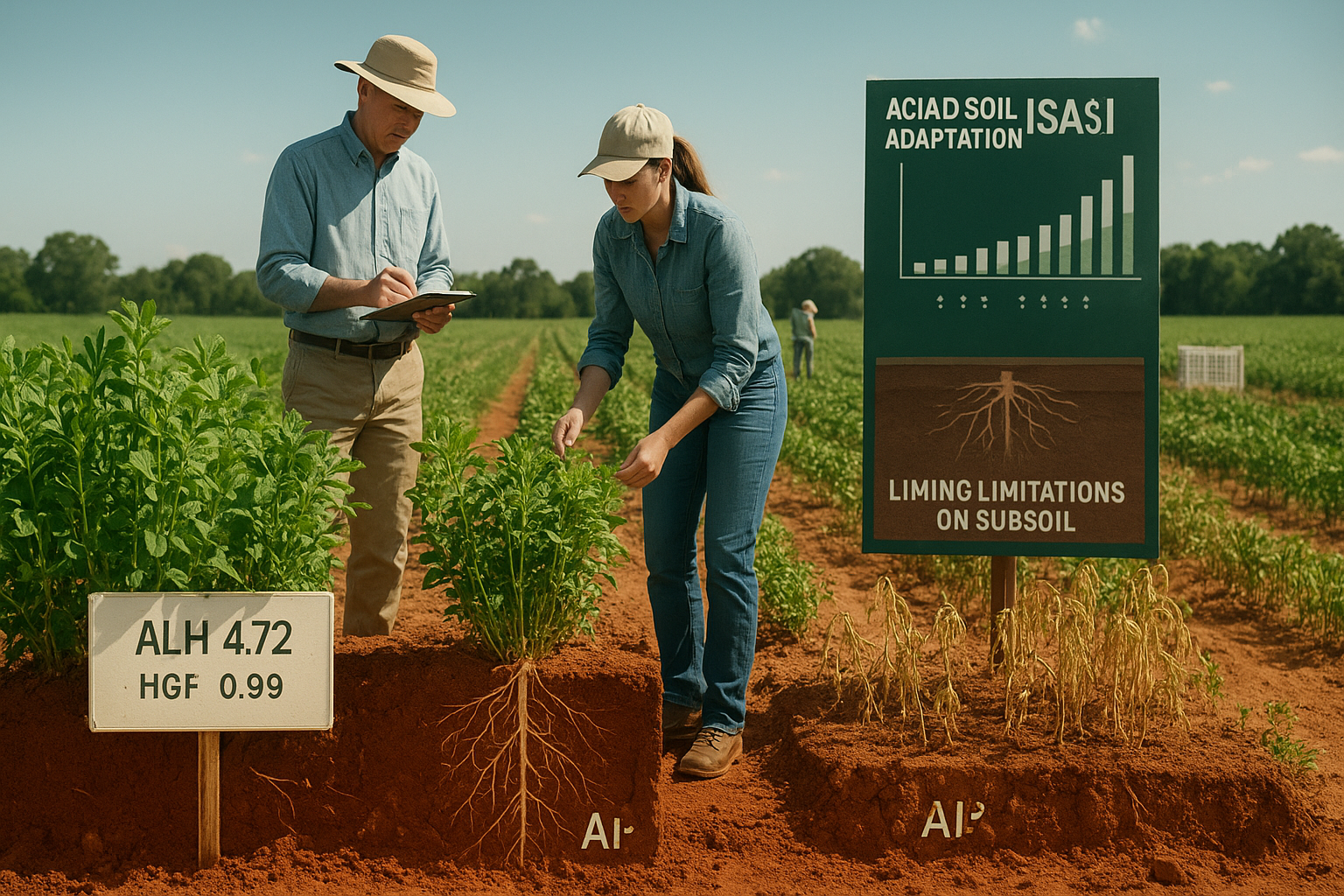
Producing economically viable alfalfa on acid soils has defeated breeders and agronomists for decades - not for lack of trying, but because the gap between controlled-environment tolerance and actual field yield has been stubbornly wide. Now, researchers at the University of Georgia have shifted the breeding methodology itself, moving away from greenhouse-first screening and toward multi-year, multi-location field evaluation as the primary selection engine. The results suggest that stable, heritable acid-soil adaptation in alfalfa is not just theoretically possible - it is measurable, selectable, and advancing toward cultivar development.
The scale of the problem gives that progress real weight. Acid soils - defined broadly as soils with pH below 5.5 where aluminum toxicity becomes a limiting factor - cover an estimated 30% to 40% of global arable land. In the southeastern United States, where rainfall leaches bases from the soil profile and livestock systems depend on high-quality forage, low-pH conditions have historically blocked alfalfa from establishing a consistent production foothold. Forage operations that have turned to point-of-sale and supply-chain platforms to manage feed procurement logistics - such as operators who rely on their platform to track inventory and purchasing cycles - understand how supply gaps in high-quality forage translate directly into cost pressure on the feed side of the ledger. Expanding alfalfa's range into acid-soil regions would widen the domestic supply base for one of the most protein-dense forages in use.
The core biological obstacle is aluminum toxicity. At pH below roughly 5.5, aluminum ions - Al3+ - become soluble in soil water and accumulate to levels that restrict root elongation, impair nutrient uptake, and inhibit the symbiotic nitrogen fixation that makes alfalfa economically attractive in the first place. Liming raises pH, reduces aluminum solubility, and restores calcium and magnesium availability. It remains a necessary management tool. The catch is that liming works well at the surface but rarely corrects subsoil pH in perennial or no-till systems, where deep incorporation is impractical. Alfalfa's deep root system - one of its defining agronomic strengths - eventually pushes into untreated acid layers regardless of how well the surface soil is managed. So liming and genetic tolerance are not alternatives; they are complementary requirements.
Why Earlier Breeding Efforts Fell Short
Two earlier populations - GA-AT, developed at the University of Georgia, and Altet-4, from the Noble Research Institute - demonstrated measurable tolerance to low pH and aluminum in controlled studies. Neither translated into a commercially useful cultivar. The reason is instructive: both populations showed acceptable performance in greenhouse assays and hydroponic systems, but forage yield under actual low-pH field conditions was too far below both limed-plot yields and regionally adapted commercial checks to justify commercial development.
Altet-4 did show a higher root dry weight ratio in unlimed soil than in limed soil, which made it useful for genetic mapping. In production terms, though, a higher root-to-shoot ratio under stress is not a selling point - it reflects resources being diverted away from the above-ground biomass that farmers actually harvest. A plant that survives acid stress by investing more in roots and less in forage solves the wrong problem.
The broader lesson here is that genotype-by-environment interaction makes acid-soil breeding genuinely difficult. A germplasm line that outperforms checks at one low-pH location in one year may lose that advantage entirely at a different site or in a season with different rainfall and temperature patterns. Single-trial selection, or selection based purely on controlled-stress assays, captures too little of that variation to be reliable.
The Field-First Selection Model
The University of Georgia program addressed these failures by inverting the conventional sequence. Rather than screening in controlled environments and then advancing promising material to field trials, the newer approach starts with field performance under acid stress and works backward to understand the mechanisms behind superior adaptation. The primary evaluation site - a field in Tifton, Georgia, with a soil pH of 4.72 and total aluminum content of 297 parts per million - provided selection pressure severe enough to separate tolerant from susceptible germplasm under real production conditions.
A panel of 1,040 accessions from the National Plant Germplasm System, plus greenhouse low-pH selections and commercial checks, was evaluated over three years in five-foot rows. Stand survival and plant vigor drove initial selection, producing 2,224 individual plants. Those selections were then evaluated at a second site - Watkinsville, Georgia, in the Piedmont region - at an adjusted pH of 6.9, allowing researchers to assess whether acid-soil adapted materials retained yield potential under favorable conditions. The best 150 accessions were crossed in bee cages to generate half-sib families for the next phase.
That second phase evaluated 140 half-sib families across paired low and adjusted pH environments at two locations over four years - a dataset spanning 25 harvests across six environments. To rank families consistently across stress and nonstress conditions, the program developed an acid soil adaptation index (ASAI): the product of a family's yield in low-pH and adjusted-pH soil, divided by the product of the respective site means. Families with ASAI values above one at both Athens and Tifton performed better than average in both environments. That structure matters because it filters out plants that merely survive stress but produce inadequate yields when conditions improve - which describes, more or less, why Altet-4 never became a commercial product.
What the Data Actually Show
Across the full multi-environment dataset, low pH significantly reduced forage yield - that finding was expected and confirmed. What was less certain going in was whether stable, broadly adapted genotypes existed within the germplasm panel, and whether family-level variation was heritable enough to support a conventional breeding response. Both questions got useful answers.
Fifty-six genotypes were identified in at least four of the six environments as performing equally well or better under low pH than under adjusted pH. That kind of cross-environment consistency is not easy to find, and finding it across a dataset this size is a meaningful result. Heritability estimates for forage yield were 0.78 under adjusted pH, 0.75 under low pH, and 0.85 for ASAI. Those figures indicate that a substantial share of the observed family differences reflected genetic factors - or at minimum, factors repeatable enough for selection to act on. Selection should generate genetic gain.
Root phenotyping added a structural dimension. Families with the highest and lowest ASAI values were characterized using rhizoboxes and field-excavated plants after five years of persistence under low-pH stress. The root data validated the field rankings and gave breeders a root architecture ideotype - a defined target morphology - to use as a surrogate selection criterion in future cycles. That matters operationally because measuring root architecture is faster and less expensive than running multi-year field trials at every breeding cycle. Once the surrogate trait is validated against field yield, it becomes a tool for accelerating selection without sacrificing predictive accuracy.
The selected genotypes from the best-performing families have already been crossed in the greenhouse and are advancing into the next cycle of recurrent selection for forage yield and persistence under low-pH conditions. The realistic near-term outcome is a first generation of cultivars with improved establishment, more consistent yield, and better stand persistence compared to current varieties in fields with acid subsoil - particularly in the southeastern U.S., where alfalfa-bermudagrass systems could benefit most from expanded acid-soil tolerance.
Low-pH alfalfa is not a single-trait problem with a single-trait fix. It is a whole-plant adaptation challenge involving root architecture, aluminum exclusion and detoxification, nitrogen fixation capacity, and regrowth after repeated harvests. The work described here treats it that way - and the evidence suggests that treating it that way is finally producing results worth building on.