
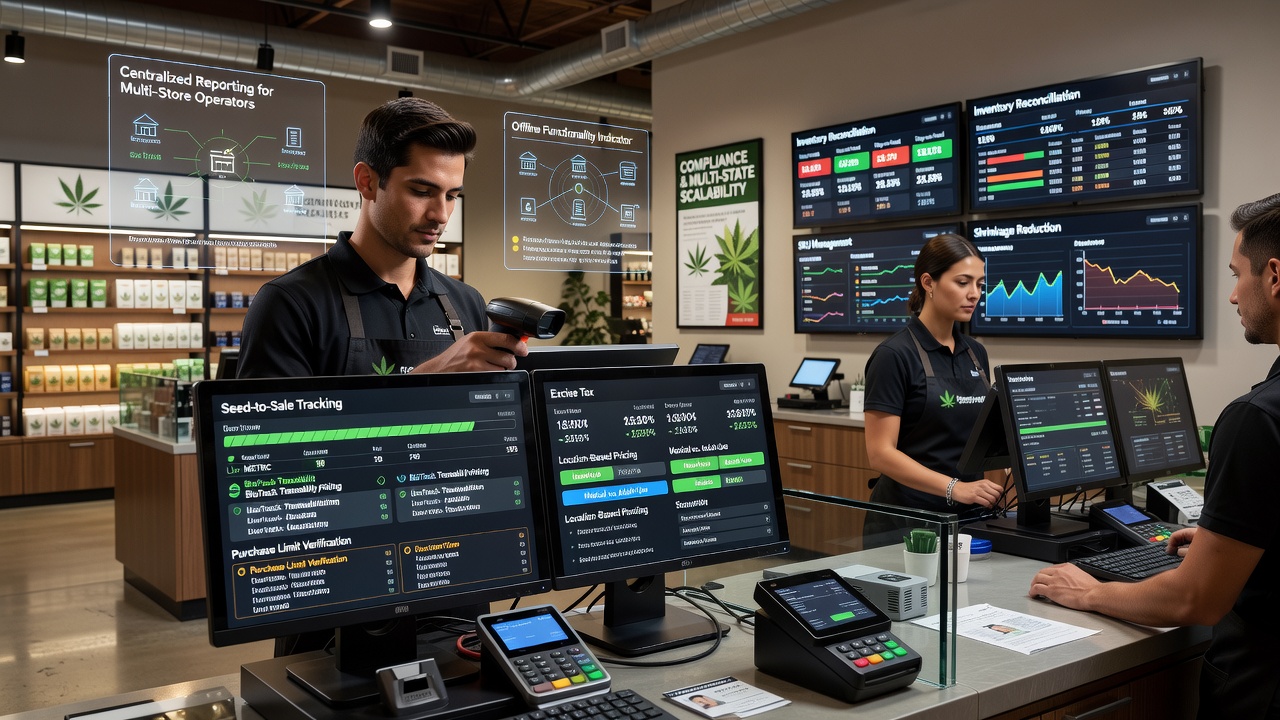
Point-of-sale technology has quietly become the central nervous system of dispensary operations, not just a checkout tool. For retailers managing seed-to-sale tracking, tax calculation, and staff accountability simultaneously, the choice of POS platform now shapes whether a store stays compliant or falls behind on audit readiness.
Why the Back Office Matters as Much as the Counter
A budtender scanning an ID is only half the transaction. Behind that screen, the system has to verify purchase limits, apply the correct excise and local tax stack, log the sale for state traceability, and update inventory in real time. Miss one of those steps, and a dispensary isn't just losing efficiency - it's exposed to a compliance gap that surfaces during an audit, sometimes months later. That's the catch with cannabis retail technology: the customer-facing experience and the regulatory backbone are the same system, whether operators treat them that way or not.
Multi-state operators feel this pressure most acutely. A platform built for a single-location shop rarely scales cleanly across jurisdictions with different tax rules, medical-versus-adult-use distinctions, and state traceability requirements like METRC or BioTrack reporting. Retailers expanding into new markets need systems that handle dual-license rules, location-based pricing, and centralized reporting without forcing staff to relearn workflows at every store.
Inventory, Shrinkage, and the Cost of Manual Work
Inventory control remains one of the quieter cost centers in cannabis retail. Manual counts, inconsistent SKU management, and delayed reconciliation all contribute to shrinkage that eats into already thin margins under 280E tax treatment. Automated reconciliation and reorder forecasting based on days-on-hand data reduce the guesswork, but only if the POS and inventory system are genuinely integrated rather than bolted together.
Offline functionality has become a baseline expectation rather than a premium feature. A dispensary that loses connectivity and can't process sales isn't just inconvenienced - it's turning away paying customers and potentially mishandling compliance logs until systems reconnect. Reliability, in that sense, is a compliance issue as much as a customer-service one.
Payments and the Push Toward Digital Transactions
Cannabis remains largely cash-reliant because federal banking restrictions limit traditional card processing. That's pushed retailers toward ACH and debit solutions integrated directly into POS platforms, which simplify reconciliation and reduce the handling risk that comes with heavy cash volume. Digital payment options also change basket behavior - customers tend to spend differently when they're not counting bills at the counter, though retailers should treat that as an operational observation, not a sales pitch.
What Operators Should Weigh Before Switching Systems
- Whether the platform integrates directly with state traceability systems like METRC or BioTrack
- How pricing and promotions handle medical versus adult-use rules automatically
- Whether reporting tools support cross-location comparison for multi-store operators
- How the system performs during connectivity outages or high-traffic periods
- Whether employee access and permissions can be set by role and location
None of this guarantees smoother operations on its own. Technology reduces friction; it doesn't replace the compliance discipline operators still need to build into daily store routines. But as cannabis retail matures into a more regulated, more competitive sector, the gap between stores running on fragmented tools and those running on integrated systems is becoming harder to ignore.