
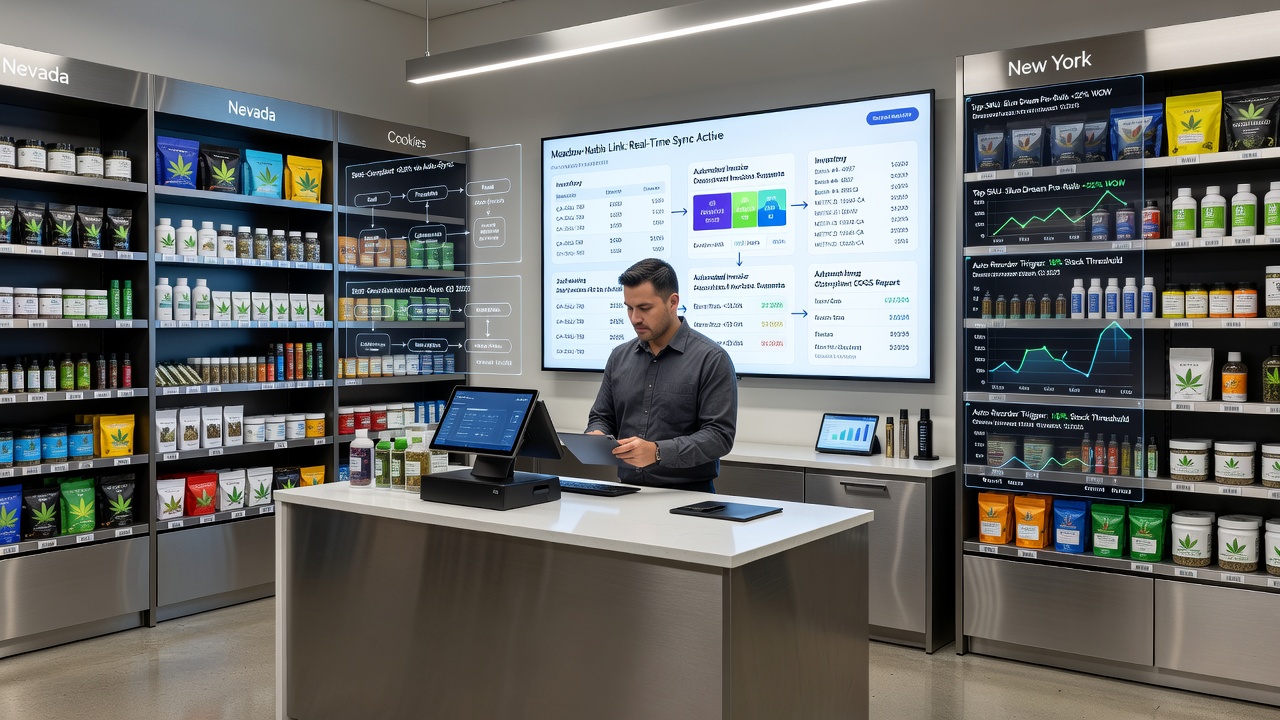
Inventory management remains one of the more stubborn operational headaches in licensed cannabis retail. Between vendor portals, manual purchase orders, and the compliance overhead that comes with tracking every gram from intake to sale, even well-run dispensaries end up with either empty shelves or dead stock tying up cash. A new integration between dispensary software provider Meadow and wholesale distributor Nabis is aimed squarely at that problem.
Why Manual Restocking Breaks Down
Cannabis retail doesn't work like conventional retail. Every SKU has to be reconciled against seed-to-sale tracking, batch numbers, and METRC tags, and every restock decision carries compliance weight, not just a business one. In practice, though, a lot of dispensaries are still running this process through a patchwork of vendor portals, spreadsheets, and phone calls to sales reps. That approach is slow, and it's exactly the kind of manual workflow where mistakes creep in - a mistyped quantity, a missed reorder point, a batch number that doesn't match the invoice. Each of those errors is a potential compliance flag, not just an inconvenience.
What the Integration Actually Does
The Meadow-Nabis connection links a dispensary's point-of-sale system directly to Nabis' wholesale marketplace, which services several hundred brands across California, Nevada, and New York. Instead of toggling between systems, store operators can trigger restock orders based on real inventory levels and sales trends without leaving their POS. SKU details, quantities, batch numbers, METRC tags, and invoice data sync automatically between the two platforms.
That matters for a few reasons. First, it narrows the gap between what's actually on the shelf and what the system thinks is on the shelf - a discrepancy that drives both stockouts and inventory shrinkage. Second, it pulls invoice data straight into Meadow, which simplifies matching purchase orders against deliveries for bookkeeping and cost tracking. Given how unforgiving 280E tax treatment already is for cannabis operators, cleaner financial reporting isn't a nice-to-have; it's a margin issue.
Forecasting Over Guesswork
The integration also supports demand forecasting, using combined sales and inventory data to flag top-selling products and set smarter replenishment cycles. That's a meaningful shift from the reorder-when-someone-notices method that still governs a lot of independent stores. For multi-location operators, the same logic scales across sites, giving each location consistent access to the wholesale marketplace rather than relying on separate, location-by-location vendor relationships.
The Compliance Angle Matters Most
Here's the catch with any automation pitch in this industry: efficiency only counts if it holds up under regulatory scrutiny. Automated restocking is only as good as the data feeding it, and cannabis retailers operate under compliance regimes where a mismatched batch number or an untracked transfer can trigger real consequences. By syncing METRC tags and invoice data automatically, the integration reduces the manual re-entry steps where compliance errors typically originate. That's a genuine risk-reduction case, not just a convenience one.
The integration is currently live in California, with plans to expand into other markets where Nabis operates. Meadow, for its part, already supports integrations across regulated markets more broadly. For an industry still maturing its back-office infrastructure - and still operating without normalized banking access in most states - tools that tighten the link between compliance data and purchasing decisions are worth watching, not because they eliminate risk, but because they narrow the margin for the kind of manual error that regulators, and accountants, tend to notice.