
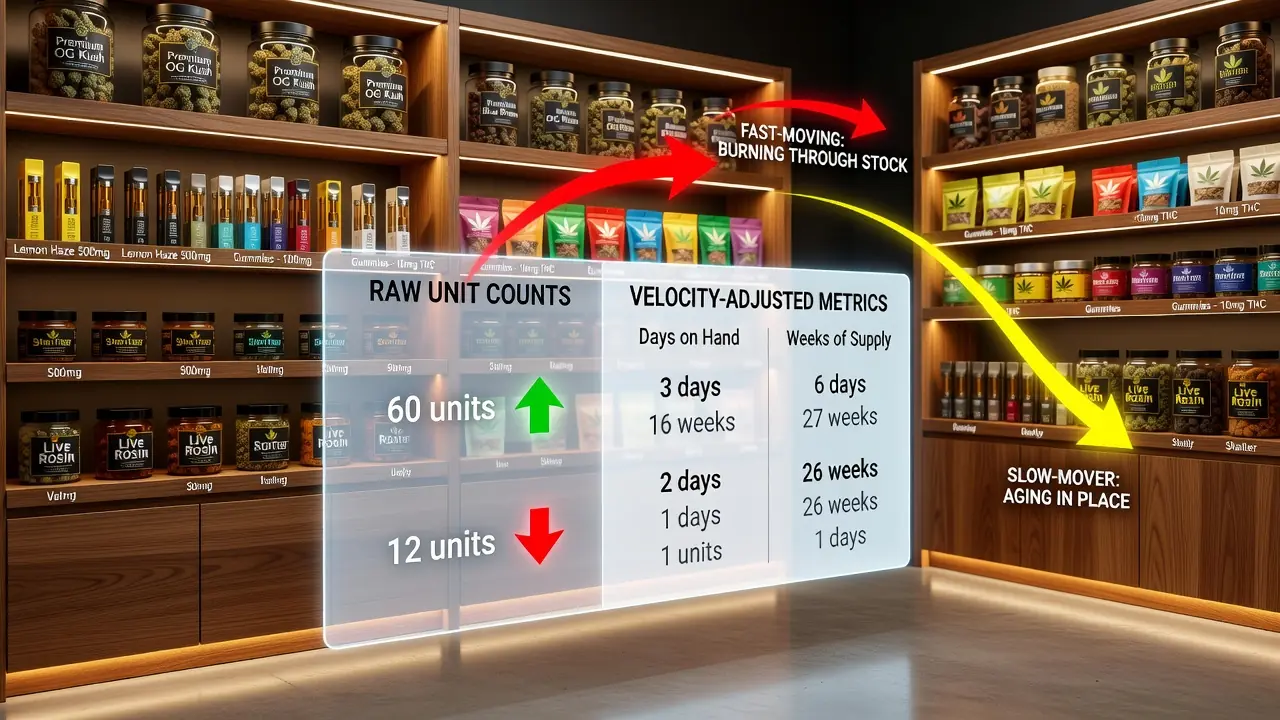
A dispensary inventory report rarely lies, but it does mislead if you read it the wrong way. Two SKUs on the same report can carry wildly different risk even when one number looks comfortable and the other looks thin. The fix isn't more data. It's one additional column most point-of-sale systems already have sitting unused.
The Problem With Counting Units Alone
Sixty units on a shelf looks like a cushion. Twelve looks like a shortage waiting to happen. That instinct is exactly backwards once velocity enters the picture, and velocity is the thing a raw inventory count never shows you. A SKU moving thirty units a week burns through twelve units in roughly three days. A SKU moving two units a week can sit on sixty units for half a year. Same report, opposite reality.
This is where Days on Hand, sometimes framed as weeks of supply, earns its keep. It's a simple ratio - units on hand divided by average sell-through - but it reframes the entire conversation around inventory. Instead of asking "how much do we have," it asks "how long will this last at the pace it's actually selling." For a cannabis retailer managing dozens or hundreds of SKUs across flower, vape, edibles, and concentrate categories, that distinction is the difference between a proactive buy and a stockout nobody saw coming.
Why This Matters More in Cannabis Than Most Retail
Cannabis inventory carries pressures that a grocery store or apparel shop doesn't deal with. Product batches are tied to lab testing and COA documentation, and a batch sitting too long risks degradation, especially with flower and certain vape formulations. Seed-to-sale tracking through state systems like METRC means every unit has a compliance footprint, not just a shelf footprint. Slow-moving inventory isn't just dead capital - it's a batch aging toward a point where budtenders start discounting it just to clear it before potency or quality concerns creep in.
There's also the tax reality. Under 280E, cannabis operators can't deduct ordinary business expenses the way other retailers can, which makes every dollar tied up in slow inventory more expensive to carry than it looks on paper. A fifty-unit pile of a product selling two units a week isn't a cushion. In practice, it's capital frozen for a season, sitting in a budroom, quietly working against the tax bill.
What Operators Should Actually Watch
Store managers reconciling wholesale menus against actual sell-through need a cleaner signal than gut feel. A few things worth tracking alongside raw unit counts:
- Days on Hand or weeks of supply, calculated per SKU, not just per category
- Sell-through velocity trends over rolling periods, not a single snapshot
- Batch age relative to lab testing dates and compliant packaging shelf stability
- Reorder points set against actual velocity rather than historical purchase habits
None of this requires new software, necessarily. Most compliance-grade POS platforms already log the sales history needed to build this column. What's missing, more often than not, is the habit of looking at it before placing an order rather than after a shelf runs empty.
The Practical Takeaway for Buy Day
Order day decisions built on unit counts alone tend to overcorrect - restocking the slow movers because the shelf looks thin on top, while the fast movers quietly run dry mid-week. Weeks of supply reframes the same numbers into a timeline, and timelines are what actually drive purchasing decisions that hold up against both compliance recordkeeping and the tax exposure built into every slow-moving batch.