
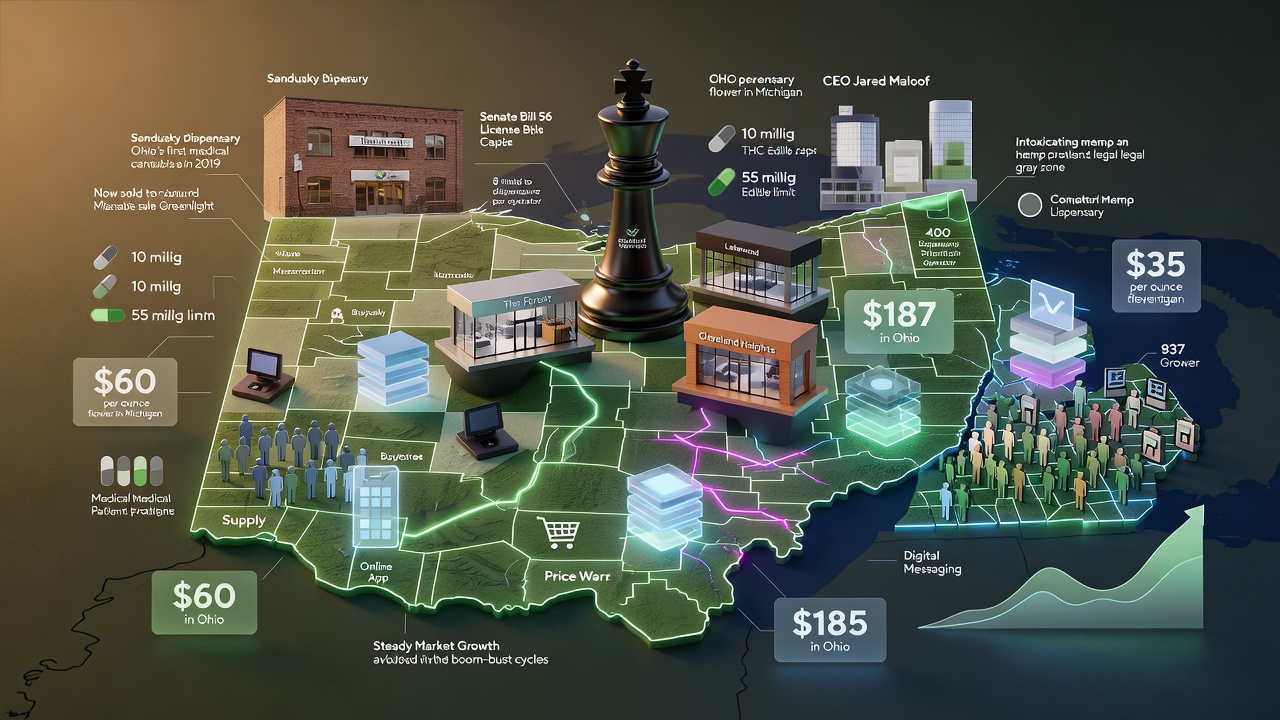
Standard Wellness CEO Jared Maloof recently sold The Forest dispensary in Sandusky, Ohio, the site of the state's first legal medical cannabis sale back in January 2019. The deal, struck with Missouri-based Greenlight, wasn't a retreat. It was a repositioning move inside what Maloof calls a retail chessboard, one shaped by license caps, local moratoriums, and a price war with Michigan just across the border.
Why a flagship store got sold
Sandusky carries real history for Ohio's cannabis program. But proximity to Michigan, where an unlimited-license structure has flooded the market with cultivators, processors, and dispensaries, made the store difficult to run profitably. Michigan's oversupply has pushed flower prices down to roughly $60 an ounce in recent months, compared to around $185 an ounce in Ohio. For a border-adjacent dispensary, that price gap is not a footnote; it's the whole business case. Customers simply drive north.
Standard Wellness responded by exiting Sandusky and another underperforming location while opening new stores in Northeast Ohio, including a flagship in Cleveland Heights and a second Forest location in Lakewood. Under Senate Bill 56, companies are capped at eight dispensary licenses statewide, with a program-wide ceiling of 400. That scarcity turns every retail decision into a trade-off. Fewer locations means each one has to work harder, which is why Maloof frames site selection as a strategic swap rather than simple expansion.
Supply discipline versus oversupply
Ohio's limited-license model, with 233 dispensaries, 37 cultivators, 45 processors, and six testing labs certified to date, has kept the market comparatively tight. That tightness supports pricing, but it also means capacity constraints are real; new cultivation and processing capacity is still coming online to relieve what Maloof describes as a market running somewhat short on supply.
Michigan offers the cautionary counterexample. Its regulators have issued licenses to 935 growers, 270 processors, and 837 dispensaries, producing a buyer's market with more than $3 billion in annual sales for three straight years, but also a wholesale price collapse that has pushed many operators toward failure. Ohio lawmakers appear to be threading a narrower path deliberately, avoiding the boom-bust cycle in favor of slower, steadier growth. Whether 233 dispensaries is the right number is debatable. Maloof puts the healthy figure closer to 300, constrained further by the sheer number of Ohio municipalities that have opted out via local moratoriums.
Regulatory friction beyond the retail floor
Senate Bill 56 reshaped more than license counts. It imposed a 10-milligram THC limit per serving for adult-use edibles, while medical patients retain access to doses up to 55 milligrams. The policy rationale centers on child safety, but it also reflects the uneven science of cannabinoid metabolism; dosing that affects one consumer negligibly can affect another significantly. The law also tightened rules around minor cannabinoids like CBN, much of which is synthetically derived rather than naturally occurring in the plant at meaningful levels.
Intoxicating hemp products remain a parallel compliance fight. Though technically prohibited since March, litigation has produced temporary restraining orders and a preliminary injunction that have allowed some retailers to keep operating in a legal gray zone. A pending federal ban could resolve the ambiguity, but until then, licensed dispensaries are competing against a loosely regulated hemp channel that doesn't carry the same testing, packaging, or age-verification obligations.
What retail technology is doing about it
With fewer storefronts allowed per operator, Ohio dispensaries are leaning harder on digital tools to maximize each location's output. Online ordering and pre-filled carts reduce in-store purchase pressure and let operators queue fulfillment before a customer arrives, smoothing demand on POS systems and budtender staffing alike. Pickup windows, loyalty platforms, and targeted digital messaging based on purchase history are becoming standard infrastructure rather than add-ons, a quiet acknowledgment that in a capped-license state, the real competitive battleground is customer retention, not shelf count.