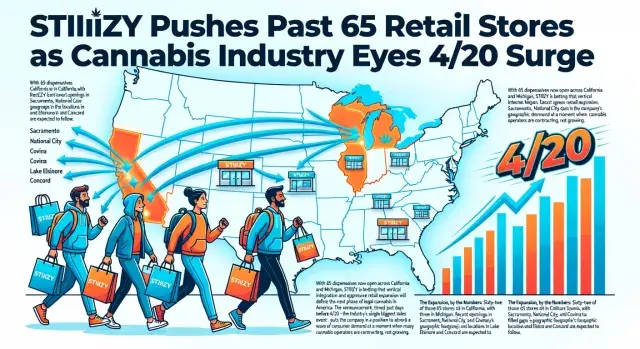
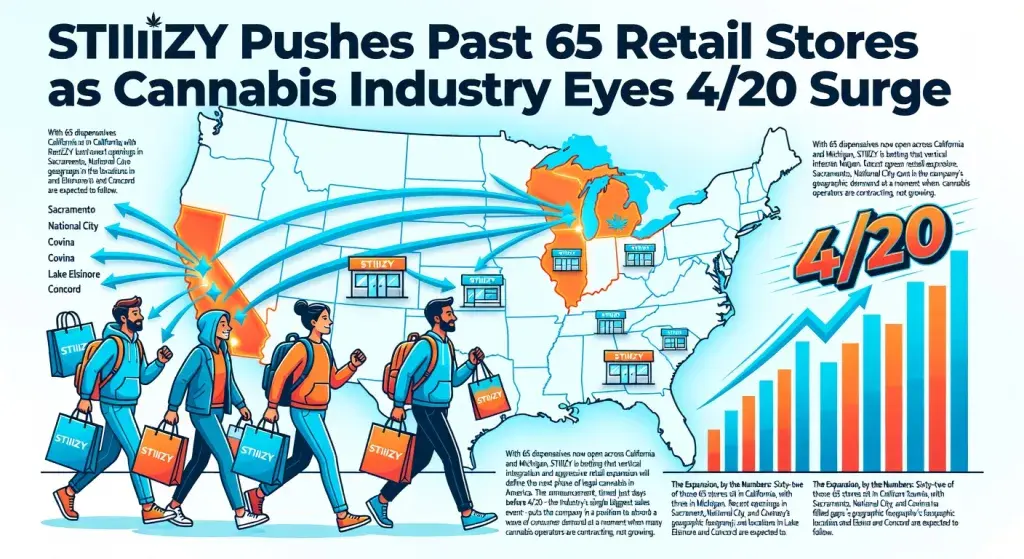
With 65 dispensaries now open across California and Michigan, STIIIZY is betting that vertical integration and aggressive retail expansion will define the next phase of legal cannabis in America. The announcement, timed just days before 4/20 - the industry's single biggest sales event - puts the company in a position to absorb a wave of consumer demand at a moment when many cannabis operators are contracting, not growing.
The Expansion, by the Numbers
Sixty-two of those 65 stores sit in California, with three in Michigan. Recent openings in Sacramento, National City, and Covina have filled gaps in the company's geographic footprint, and locations in Lake Elsinore and Concord are expected to follow. STIIIZY also confirmed it is integrating 12 retail locations from its acquisition of Gold Flora, a deal that materially broadens its physical presence without the slower grind of ground-up buildouts.
The company says it plans to add at least five more stores before year's end. That's an ambitious clip in an industry where licensing, local permitting, and real estate challenges routinely stall timelines by months.
Why Retail Density Matters in Cannabis
Here's the thing about cannabis retail: it isn't like most consumer categories. Online ordering exists in limited form, but the actual transaction still happens in-store, governed by state-by-state regulations that make e-commerce as mainstream consumers know it essentially impossible. That constraint makes physical retail footprint a genuine competitive moat - not a legacy burden.
California alone generates more than $300 million in legal cannabis sales per month, according to STIIIZY's figures. Yet the state's market is also notoriously fragmented. Thousands of licensed operators compete alongside a persistent illicit market that undercuts on price and sidesteps taxation. For a brand trying to build consumer loyalty, being physically present - repeatedly, consistently, across regions - is less a luxury than a prerequisite.
STIIIZY's approach leans hard on standardization. Each store follows the same protocols for layout, product education, and visual merchandising. The goal, as president Tak Sato put it: "Product, pricing, and experience are aligned. That consistency is what keeps customers coming back." It sounds tidy on paper, but in practice, maintaining uniform operations across 65 locations - especially during rapid integration of acquired stores - is a logistical grind that has tripped up larger retailers in other sectors.
The 4/20 Factor and Broader Market Pressures
April 20 functions as the cannabis industry's Black Friday. Sales volumes spike dramatically, and operators plan inventory, staffing, and promotions around the date weeks in advance. For a company with STIIIZY's retail density, the holiday represents an outsized revenue opportunity - but also an operational stress test.
The broader context is less celebratory. California's legal cannabis market, while enormous in absolute terms, has been under sustained pressure. High tax rates, slow local licensing, and competition from unlicensed sellers have squeezed margins across the supply chain. Multiple multi-state operators have restructured, closed stores, or exited markets entirely over the past two years. STIIIZY's expansion runs counter to that trend, which makes it either a sign of genuine operational strength or a bet that scale will eventually reward those who survive the shakeout. Probably both.
Vertical integration - controlling cultivation, manufacturing, distribution, and retail under one roof - gives STIIIZY more leverage over its cost structure than operators who rely on third-party supply chains. It's not a novel strategy; it's borrowed directly from the playbook of consumer packaged goods companies that learned long ago that owning the shelf matters as much as owning the product. But in cannabis, where interstate commerce remains federally prohibited, vertical integration has to be rebuilt state by state. That's expensive, slow, and capital-intensive.
What Comes Next
STIIIZY's Michigan presence - three stores so far - hints at a broader multi-state ambition, though the company hasn't disclosed a detailed timeline for expansion beyond California. Michigan's cannabis market has matured rapidly, with aggressive price compression that has tested even well-capitalized operators. Whether STIIIZY's California model translates cleanly into other regulatory environments remains an open question.
For now, the company is doing something relatively uncommon in cannabis: growing its retail footprint while the industry around it consolidates. That divergence will attract scrutiny. Investors, regulators, and competitors will all be watching whether 65 stores - and counting - represent sustainable scale or overextension in a market that hasn't finished correcting. The answer probably won't arrive by 4/20. But the holiday will offer a useful data point.