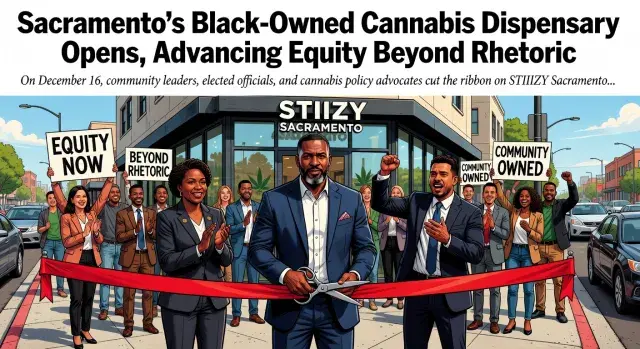
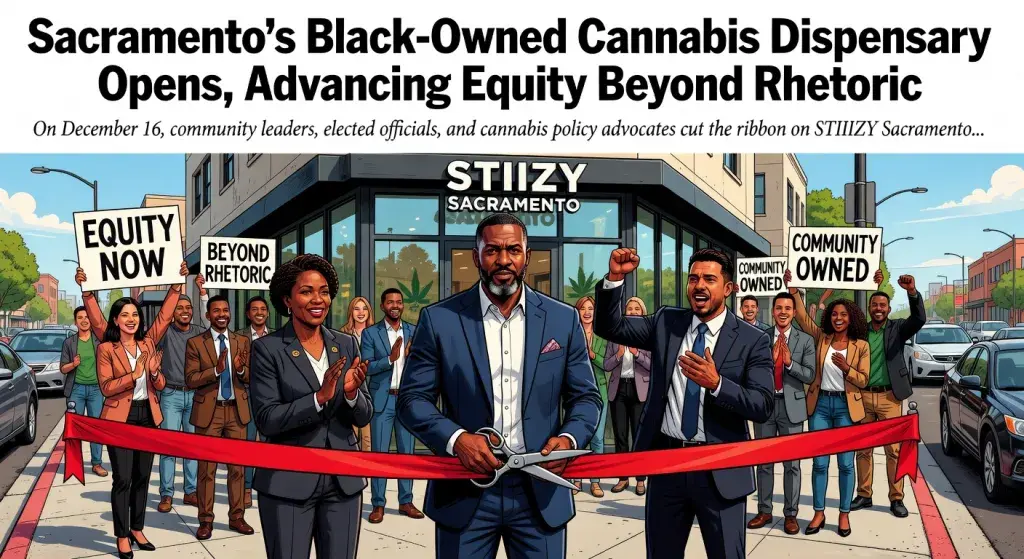
On December 16, community leaders, elected officials, and cannabis policy advocates cut the ribbon on STIIIZY Sacramento - a Black-owned dispensary at 4080 24th Street that represents one of the most concrete equity wins the city's cannabis sector has produced. Founded by Malaki Amen, a longtime Sacramento activist and policy reform advocate, the dispensary opens in partnership with STIIIZY, the nation's best-selling cannabis brand. The ceremony marks the store's pre-opening phase, with grand opening dates still forthcoming.
More Than a Storefront
Cannabis equity programs exist in dozens of cities across the country. Most of them look better on paper than in practice. The barriers to entry - real estate costs, licensing delays, capital requirements that can stretch into six or seven figures - have a way of filtering out exactly the people equity policies were designed to help. That's the backdrop against which Amen's dispensary matters.
Amen has spent years working in community economic development and drug policy reform in Sacramento. His path to dispensary ownership didn't begin with a business plan; it began with advocacy. "Our fight has always been about empowering ourselves to heal and repair the harm of criminalization," he said at the ribbon-cutting. "Equity becomes real when the communities targeted by the war on drugs are not just included, but are thriving economically."
That distinction - between inclusion and economic self-determination - is not a small one. Many equity applicants in California's cannabis market have secured licenses only to find themselves unable to operate, stuck in regulatory limbo, or forced into lopsided partnerships that left them owners in name only. Amen's partnership with STIIIZY, by contrast, appears designed to combine an equity license holder's community roots with the operational infrastructure and brand recognition of a major cannabis company.
The War on Drugs Left Receipts
Sacramento's cannabis equity efforts exist for a reason. For decades, drug enforcement fell disproportionately on Black and Latino communities - not because of higher rates of use, but because of how policing resources were deployed. Arrest data, sentencing records, the downstream economic wreckage of felony convictions: the evidence is extensive and well-documented. California voters legalized recreational cannabis in 2016 with Proposition 64, which explicitly acknowledged this history and directed tax revenue toward communities harmed by prohibition.
But acknowledgment and repair are different things. Statewide, California's equity licensing programs have been plagued by underfunding, slow rollouts, and a persistent gap between the people who qualify for equity licenses and the people who can actually afford to build out a dispensary. The capital demands are enormous. A single retail location can require hundreds of thousands of dollars before it ever opens its doors.
This is where the STIIIZY partnership matters structurally. The brand, founded in 2017, has grown into one of the most recognized names in legal cannabis, with a retail and product footprint that stretches across multiple states. For an equity operator like Amen, that kind of partnership can bridge the capital and operational gap that has stalled so many other equity ventures.
What Comes Next
The ribbon-cutting is a beginning, not an endpoint. STIIIZY Sacramento still needs to announce its grand opening events and prove it can operate profitably in a retail cannabis market that remains fiercely competitive - and, in California, notoriously difficult. The state's legal market continues to contend with an entrenched illicit market, high tax burdens, and regulatory overhead that squeezes margins thin.
Still, Amen's dispensary stands as something concrete in a policy space often crowded with good intentions and thin results. A Black-owned cannabis dispensary, backed by a major brand, opening in the capital of the state that pioneered medical cannabis - there's a certain symmetry to it. Whether it becomes a model or remains an exception depends on factors well beyond one storefront: state funding for equity programs, local permitting reform, and the willingness of established cannabis companies to enter partnerships that share real ownership and real revenue.
For now, though, the doors at 4080 24th Street are about to open. That alone is worth marking.